
A Student Readiness, University Accountability, and Completion-Based Model for Higher Education
Chauncey W. Crandall IV, MD, FACC, FACP
White Paper — Policy Recommendation
Executive Summary
The federal student-aid system was built to expand educational opportunity, and it has succeeded in enabling millions of Americans to attend college who could not otherwise have afforded it. But the system carries a structural weakness: federal money can be committed before there is any real determination that a student is academically prepared, personally committed, financially capable of remaining enrolled, or reasonably likely to complete the program being financed.
Three distinct problems follow from that weakness. First, outright fraud — false identities, “ghost students,” organized fraud rings, and applicants whose real objective is the aid check rather than the education. Second, legitimate students who enroll in good faith but face a low probability of completion because of weak preparation, financial instability, or a poor fit between the program and their goals. Third, institutions that face little financial consequence when a student they enrolled, and were paid to educate, never graduates.
The Department of Education’s own enforcement record shows how large the fraud problem has become: the Department reported that more than $1 billion in attempted federal student-aid fraud was prevented between January 2025 and December 2025, after tightening identity verification following a wave of schemes involving stolen identities, AI bots posing as students, and coordinated fraud rings. In April 2026, Federal Student Aid began real-time fraud screening of FAFSA applications, and roughly 300,000 previously submitted 2026–27 applications were flagged for enhanced verification. These figures confirm that identity fraud is a genuine and growing threat — but fraud is only one part of a larger completion problem that this paper addresses.
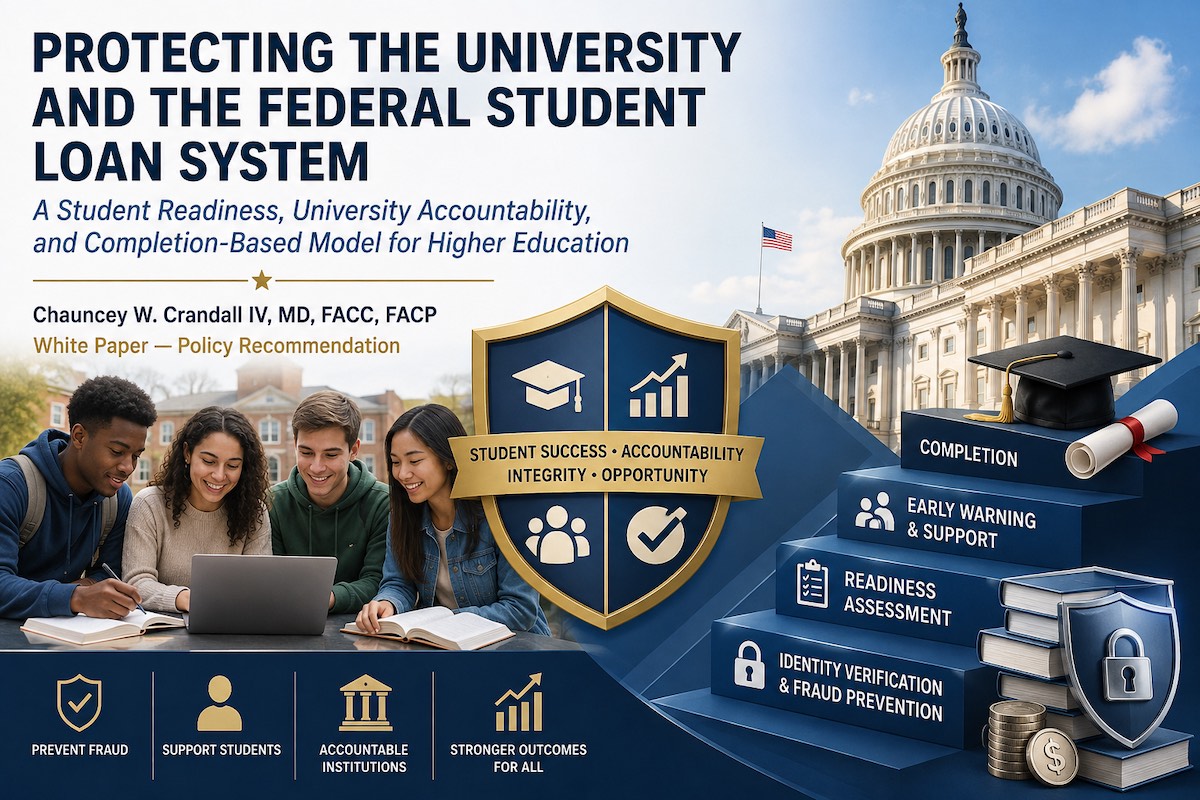
This paper recommends moving federal financing from an enrollment-based model to a completion-oriented model, built on four pillars: a standardized Student Completion Readiness Score, stronger identity verification, early-warning intervention, and greater institutional financial accountability for outcomes.
I. The Problem: Federal Dollars Advanced Before Success Is Established
College non-completion is a serious financial problem because a student who leaves without a degree may carry substantial debt without the economic benefit expected to make repayment possible. Among first-time, full-time students who began bachelor’s programs, NCES reports a six-year graduation rate of approximately 64 percent overall — 68 percent at private nonprofit institutions, 63 percent at public institutions, and only 29 percent at private for-profit institutions. That sector gap alone demonstrates that completion is not simply a matter of individual effort — it is closely tied to the institution a student attends and the support that institution provides.
Part-time enrollment, employment pressure, weak academic preparation, financial stress, and competing family obligations are all repeatedly associated with a higher risk of interrupted enrollment. Student failure, in other words, is not simply a student problem. It is a student-selection, financing, institutional-support, and accountability problem — and it should be treated as one before large amounts of federal debt accumulate, not after.
The question should not be asked only after a student has already borrowed and already withdrawn. It should be asked before the debt is incurred.
II. Fraud Must Be Distinguished From Educational Failure
A student who leaves college or a course because of illness, financial hardship, family disruption, or academic difficulty is not committing fraud. Deliberately creating false identities, falsifying eligibility, enrolling fictitious students, or entering a program primarily to obtain an aid refund is fraud — and the Department of Education has specifically identified sophisticated fraud rings, identity theft, automated bot applications, and so-called “ghost students” as active threats to Title IV programs.
The federal response should therefore follow three distinct pathways: approve ordinary aid for the legitimate, prepared student; provide aid with enhanced support and staged financing for the legitimate but high-risk student; and delay disbursement pending verification for the possible fraudulent applicant. The goal is not to deny opportunity to disadvantaged students — it is to identify preventable failure before it occurs.
III. The Student Completion Readiness Score
Every institution participating substantially in federal student-aid programs should conduct a standardized Student Completion Readiness Assessment before a new student assumes significant federally supported debt. The score should measure factors demonstrated to predict persistence — never race, religion, ethnicity, or other protected characteristics.
| Readiness Factor | Max Pts |
|---|---|
| Academic preparation and prerequisite achievement | 20 |
| Demonstrated educational / career objective | 15 |
| Financial plan and ability to meet living expenses | 15 |
| Commitment to full-time or appropriate course load | 10 |
| Reasonable employment / time obligations | 10 |
| Prior attendance, reliability, and completion history | 10 |
| Family / community / support structure | 5 |
| Understanding of program requirements and costs | 5 |
| Evidence of self-discipline and time management | 5 |
| Interview assessment and personal commitment | 5 |
| TOTAL | 100 |
| Score | Classification | Response |
|---|---|---|
| 80–100 | Standard Risk | Ordinary federal-aid eligibility and standard advising. |
| 65–79 | Moderate Completion Risk | Full aid eligibility, plus a formal completion plan, assigned adviser, tutoring, and scheduled monitoring. |
| Below 65 | High Support Requirement | Not automatic denial — targeted remediation, reduced load, or financial/academic support before further borrowing. |
The purpose of the score is intervention, not exclusion. A low score should trigger academic remediation, a reduced course load, employment adjustment, childcare assistance, tutoring, or a less expensive pathway — not automatic denial.
IV. The University Must Share Responsibility
A central weakness of the current system is the separation between the institution that receives tuition and the taxpayer that bears much of the lending risk. Universities receiving substantial federal aid funds should be evaluated annually on first-year retention, degree completion, student debt at completion, non-completion with debt, loan repayment performance, postgraduate employment outcomes, and rates of suspicious or fraudulent enrollment.
Institutions with consistently strong outcomes should face minimal additional regulation. Institutions with persistently poor outcomes — low completion, inadequate intervention, and high default — should gradually assume a share of the resulting federal loss. The institution that receives the money should have a financial interest in the student’s success.
V. Intervention Before the Student Drops Out
Federal policy should encourage universities to identify deterioration immediately — repeated absences, missed assignments, failing grades, unpaid balances, excessive employment, repeated withdrawals, and loss of contact with advisers are all established warning signs. The Department of Education’s Institute of Education Sciences specifically recommends comprehensive, proactive advising rather than waiting for students to seek help only after serious difficulty has already developed.
A student showing several warning signs should trigger a mandatory Student Success Conference before additional federal aid is released for the next term. The principle is simple: do not wait for the student to fail and then calculate the financial consequences. Intervene while the student can still succeed.
VI. Reforming Return of Title IV Into Broader Accountability
Current Return of Title IV (R2T4) regulations require institutions to calculate and return unearned federal aid when a student withdraws during a payment period, on defined federal deadlines. That protects federal funds during the term of withdrawal, but it does not ask the larger question: why did the student fail to complete, and could that failure reasonably have been predicted or prevented?
A Completion Accountability Framework should sit alongside R2T4. The government would continue determining the financial consequences of an individual withdrawal, but would also track institutional patterns — because one dropout is an individual event, while hundreds of similar dropouts from the same institution or program point to a systemic problem.
VII. A Better Federal Student-Aid Model
- Verify the student — use modern identity verification and fraud detection before releasing funds.
- Evaluate readiness — require a Student Completion Readiness Score before substantial federal borrowing.
- Match borrowing to educational value — avoid excessive debt for programs unlikely to support repayment.
- Intervene early — identify failing attendance, participation, and performance before students disappear.
- Make institutions accountable — share financial risk for persistently poor completion and repayment outcomes.
Conclusion
Federal student aid should remain a pathway to opportunity. It should not become an automatic transfer of taxpayer-backed money simply because an individual enrolls. The goal of reform is not to keep disadvantaged Americans out of college — it is to help more of the students who enter college actually leave with a meaningful credential, employable skills, manageable debt, and improved economic opportunity.
The fundamental measure of success should change from “How many students did the university enroll?” to “How many students did the university successfully educate, retain, graduate, and prepare for productive employment?” A Student Completion Readiness Score, coupled with early intervention, fraud detection, responsible lending, and institutional risk-sharing, would begin aligning the interests of the student, the university, the federal government, and the American taxpayer.
Federal educational financing should reward successful education — not simply successful enrollment.