
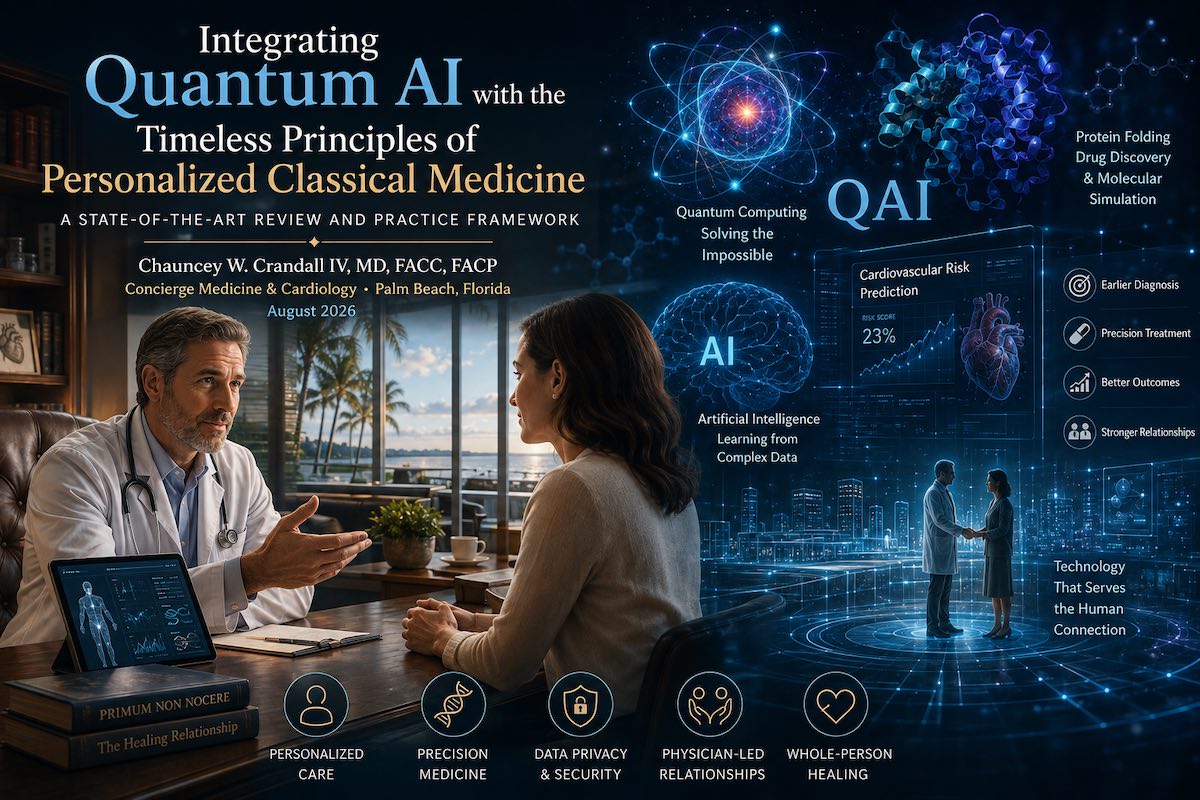
A State-of-the-Art Review and Practice Framework
Chauncey W. Crandall IV, MD, FACC, FACP
Concierge Medicine & Cardiology
Palm Beach, Florida
August 2026
Abstract
Quantum computing and quantum-enhanced artificial intelligence — together referred to throughout this paper as “quantum AI” or QAI — are moving from theoretical promise toward early, demonstrable clinical relevance. In 2026, quantum hardware providers reported error-correction milestones long treated as aspirational, hospital systems and academic medical centers began piloting quantum-assisted approaches to protein folding and molecular simulation, and peer-reviewed literature on quantum machine learning in diagnostics, drug discovery, genomics, and cardiovascular risk prediction expanded rapidly. At the same moment, an older and equally urgent question persists: what happens to the physician-patient relationship as computational power accelerates past the pace at which trust, judgment, and human attention can be built?
This white paper synthesizes the current peer-reviewed evidence base on quantum AI in clinical medicine — spanning diagnostics and medical imaging, drug discovery, precision medicine and multi-omics, cardiovascular applications, clinical decision support, hardware and error-correction progress, and data security — and situates that evidence within a specific and underexamined vantage point: the solo, direct-care, concierge medicine practice, a setting defined by small patient panels, unhurried encounters, and continuity of relationship. We examine two related questions directly: first, how quantum AI reshapes the physician’s daily workplace and the classical model of exploratory diagnosis — moving medicine from sequential, trial-and-error testing toward faster, more targeted diagnosis and treatment selection, and how that shift can be measured rather than merely asserted; and second, how quantum AI enables a more efficient, more predictive model of wellness and preventive care, and what that is worth to patient and physician alike. We argue that quantum AI’s greatest value to medicine will not be realized by replacing the physician but by extending the physician’s diagnostic reach and predictive horizon, freeing time and attention for the irreducibly human work of listening, discerning, and healing. We propose a practical, five-part framework by which independent and concierge practices can responsibly evaluate, adopt, and govern these emerging tools, together with a structured system of metrics — diagnostic, economic, systemic, and experiential — by which the value of quantum AI in a given practice can be measured rather than assumed. We close with a philosophical and ethical case for why the classical model of medicine — physician-led, relationship-centered, and oriented to the whole person — remains the necessary foundation onto which any quantum-era technology must be built, not the tradition it is destined to replace.
Introduction: The Paradox of Progress
Medicine has always advanced along two currents at once. One current is technical: the stethoscope, the electrocardiogram, the magnetic resonance image, the genomic sequencer, and now the algorithm. The other current is relational: the physician who sits with a patient long enough to notice what the chart does not say. Historically, these two currents have been treated as separable — technology in one hand, bedside manner in the other. The premise of this paper is that they are not separable, and that the arrival of quantum artificial intelligence makes the union of the two more urgent, not less.
Quantum computing exploits the properties of quantum mechanics — superposition, entanglement, and interference — to represent and manipulate information in ways that classical, binary computers cannot. Where a classical bit is either 0 or 1, a quantum bit, or qubit, can exist in a superposition of both states simultaneously, and multiple qubits can become entangled such that the state of one is correlated with the state of another regardless of distance. Quantum interference allows correct computational paths to reinforce one another while incorrect paths cancel out, effectively steering a calculation toward the right answer. The practical consequence is that certain classes of problems — modeling molecular interactions, searching enormous combinatorial spaces, optimizing across thousands of correlated variables — can, in principle, be solved with far greater efficiency than classical computers allow.
For most of its history, this has been a promise confined to physics departments and theoretical papers. That is changing quickly. Industry and academic literature moving through 2025 and into 2026 describes a decisive shift from isolated quantum demonstrations toward hybrid architectures, in which quantum processors handle narrow, computationally explosive sub-problems while mature classical AI systems continue to manage workflow, data integration, and clinical decision logic. Biotechnology firms are applying quantum simulation to protein-folding problems in neurological disease research; pharmaceutical and financial institutions increasingly describe quantum computing not as a distant bet but as a live strategic question for research and development; and 2026 itself has been described by industry observers as an inflection year in which quantum hardware and software stacks jointly crossed thresholds — sustained error correction, below-threshold logical qubits, real-time error decoding — that had previously been treated as multi-year aspirations.
This paper is written from the vantage point of a practicing cardiologist and internist operating a solo, all-cash concierge practice — a model built deliberately around small patient panels, same-day access, and long-form visits. It asks a specific question that is too often skipped in the broader excitement over quantum AI: what does this technology mean not for the hospital system or the pharmaceutical pipeline, but for the individual physician sitting across from an individual patient? And what, if anything, should never change no matter how powerful the machine in the next room becomes?
Part I — Understanding Quantum AI: A Primer for Clinicians
1.1 From Bits to Qubits
A classical computer, however powerful, stores and processes information as bits — discrete 0s and 1s. A quantum computer stores information in qubits, which can occupy a superposition of 0 and 1 at once. When qubits are entangled, measuring one instantaneously constrains the possible states of another. These properties — superposition, entanglement, and interference — allow a quantum system to represent an exponentially larger space of possibilities than an equivalent number of classical bits, and to explore many potential solutions to a problem in parallel rather than sequentially.
This is not “faster classical computing.” It is a different computational paradigm, useful for a specific and important category of problems: those involving enormous combinatorial complexity, high-dimensional correlation, or the simulation of quantum systems themselves — which, notably, includes molecules, the basic unit of biology and pharmacology.
1.2 What “Quantum AI” Actually Means
“Quantum AI” generally refers to one of three overlapping approaches now under active development:
- Quantum machine learning (QML) — using quantum processors, quantum kernel methods, or variational quantum circuits to accelerate the training or execution of machine learning models, particularly for pattern recognition in very high-dimensional or noisy datasets.
- Quantum-assisted simulation — using quantum computers to simulate molecular and biochemical interactions, including protein folding, drug-target binding, and enzyme behavior, which are computationally intractable for classical machines at meaningful scale.
- Quantum optimization — using quantum or quantum-inspired algorithms to solve large-scale scheduling, resource allocation, and risk-modeling problems, such as those found in hospital operations, population health management, radiation treatment planning, and actuarial forecasting.
Nearly all near-term clinical applications take a hybrid form. Classical computers handle data preprocessing, feature extraction, and routine computation; quantum processors address specific subroutines where a quantum advantage is plausible — kernel evaluation, combinatorial optimization, molecular simulation; and results are integrated back into classical frameworks for interpretation and clinical use. This hybrid quantum-classical architecture, rather than a wholesale replacement of classical computing, is the dominant model described across the current literature, and it is the model most relevant to practicing physicians over the next five to ten years.
The question for medicine is not whether quantum machines will think faster than we do. They will. The question is what they will be permitted to decide, and what must remain the physician’s alone.
1.3 Why Medicine, Specifically
Biology is, at its foundation, a quantum system. Protein folding, enzymatic reactions, and molecular binding are governed by quantum mechanical behavior that classical computers can only approximate, often at enormous computational cost. This is why drug discovery, genomics, and molecular diagnostics are consistently identified in the literature as the earliest and most natural application domains for quantum-assisted computing in the life sciences — the technology is, in a sense, speaking biology’s native language for the first time.
1.4 Current Quantum Hardware: The Noisy Intermediate-Scale Era and the 2026 Inflection
Current quantum hardware has, for most of the last decade, operated in what researchers term the Noisy Intermediate-Scale Quantum (NISQ) era: machines with limited qubit counts and significant susceptibility to decoherence, the loss of quantum information through environmental interference. Hybrid approaches have mitigated these limitations by delegating only quantum-advantageous tasks to quantum processors while leaning on mature classical infrastructure for the remainder of the computational pipeline.
2026 has been described by industry observers as a genuine inflection point in this trajectory. Google’s Willow processor demonstrated below-threshold quantum error correction — meaning that, for the first time, adding more physical qubits to a system decreased the overall logical error rate rather than compounding it, validating the scaling behavior that fault-tolerant quantum computing depends on. IBM has reported real-time error decoding on its Loon processor using quantum low-density parity-check codes at speeds representing an order-of-magnitude improvement over prior methods, and has stated a public roadmap targeting demonstrable quantum advantage by the end of 2026 and fault-tolerant quantum computing by 2029, with intermediate processors intended to deliver logical qubits and quantum memory. Google’s own roadmap targets error-corrected quantum computers later in the decade. None of this means clinically deployable, fault-tolerant quantum computers exist today — they do not — but it substantially shortens the runway between laboratory demonstration and health-system-relevant pilot programs, and it is why 2026 marks a reasonable moment for practicing physicians to begin paying close attention rather than treating quantum computing as a subject for physicists alone.
Part II — The Current Evidence Base: Where Quantum AI Is Already Touching Health Care
As of 2026, quantum computing in medicine remains predominantly a research, pharmaceutical, and infrastructure story rather than a bedside one. Multiple systematic reviews published between 2025 and early 2026 — spanning clinical care broadly, medical diagnostics and treatment, digital health, and healthcare algorithms generally — converge on a consistent picture: quantum AI shows measurable, reproducible promise across specific, narrow problem classes, while remaining constrained by hardware limitations, evidence gaps, and the absence of regulatory pathways. It is nonetheless instructive for the practicing physician to understand where the technology is gaining real traction, because these early beachheads foreshadow what will eventually reach the clinic.
2.1 Diagnostics and Medical Imaging
A systematic analysis of thirty-five studies published between 2015 and 2024 found consistent evidence that quantum computing techniques can improve diagnostic accuracy in medical imaging pipelines, with the authors highlighting potential for earlier detection of conditions including Alzheimer’s disease, cancer, and osteoarthritis. Several more recent and more specific demonstrations reinforce this finding. Benchmarking on the widely used MedMNIST dataset using 127-qubit IBM quantum hardware demonstrated the feasibility of quantum models for medical image classification once appropriate error suppression and mitigation techniques were applied. A hybrid quantum-classical approach combining a ResNet convolutional architecture with quantum transfer learning achieved 95 percent accuracy in MRI-based brain tumor classification, a fourteen-percentage-point improvement over conventional convolutional neural network models tested on the same data. Separately, quantum kernel-based support vector machines achieved 94.3 percent accuracy classifying autism spectrum disorder from metabolomic data on real quantum hardware — performance comparable to, though not dramatically better than, a classical support vector machine’s 93.7 percent accuracy on the same task.
The pattern across this literature is important for clinicians to hold in mind: current quantum-enhanced imaging and classification models are, in most published studies, achieving performance roughly comparable to strong classical methods, occasionally with meaningful improvement, rather than the dramatic leaps sometimes implied by press coverage. The value at this stage is proof of feasibility on real quantum hardware, not yet demonstrated clinical superiority sufficient to change practice.
2.2 Drug Discovery and Development
Quantum machine learning has demonstrated particular promise across the drug discovery pipeline. Quantum algorithms can model molecular interactions with greater fidelity than classical approximations for certain problem sizes, addressing a computational bottleneck long recognized as one of pharmacology’s most expensive challenges. In drug-target interaction prediction, a quantum-kernel framework using quantum support vector regression achieved 94.21 percent accuracy on the widely used DAVIS benchmark dataset and an extraordinary 99.99 percent on the KIBA dataset, substantially outperforming classical comparator models. In predicting ADME-Tox properties — absorption, distribution, metabolism, excretion, and toxicity, the profile that determines whether a promising molecule can safely become a drug — quantum kernel methods combined with classical support vector classifiers achieved area-under-curve values of 0.80 to 0.95. Quantum generative models are also being actively explored for de novo molecular design, in which a system proposes entirely novel candidate compounds rather than merely evaluating existing ones.
These results, drawn from some of the most mature quantum AI applications now published in the biomedical literature, shorten the earliest and most expensive phase of drug development — candidate identification — which historically consumes years and enormous capital before a single patient ever receives a dose.
2.3 Precision Medicine and Multi-Omics
Quantum computing addresses a set of needs central to precision medicine: integrating multi-omic datasets spanning genomic, epigenomic, transcriptomic, and proteomic data; discovering biomarkers through high-dimensional analysis that strains classical statistical bandwidth; inferring gene networks and prioritizing variants of uncertain significance; and simulating protein folding using quantum algorithms rather than classical approximations. For concierge and precision-medicine practices already incorporating genomic risk panels into patient care, this points toward a future of genuinely individualized risk stratification rather than population-averaged guidelines — though, as detailed in Part IV below, this future is not yet realized in routine clinical workflows.
2.4 Cardiovascular Applications
Because this paper is written from a cardiology practice, the cardiovascular literature deserves particular attention. A comparative review published in early 2026 evaluated twelve studies applying quantum neural networks against classical machine learning for cardiovascular disease risk prediction, finding that quantum machine learning approaches offer a promising, though not yet conclusively superior, alternative as datasets grow in scale and dimensionality. Related work has applied quantum-enhanced ensemble models, quantum k-means clustering, and hybrid quantum-classical neural networks to coronary heart disease and heart-failure detection, generally reporting performance comparable to strong classical baselines, with some studies reporting modest accuracy gains on specific datasets.
A more recent critical review specifically of cardiovascular medicine identified three genuine near-term application areas: quantum sensing, including superconducting quantum interference device (SQUID) magnetocardiography with potential application to cardiomyopathy detection; quantum computing applied directly to cardiovascular risk prediction; and next-generation quantum sensors for mobile, non-contact cardiac imaging that do not require the cryogenic cooling and shielding current magnetocardiography equipment demands. The same review noted that hybrid quantum-classical digital twin approaches are being explored to augment hemodynamic simulation and to model lipid interactions and plaque destabilization at something closer to a molecular level — directly relevant to the mechanistic understanding of atherosclerotic plaque rupture that underlies acute coronary syndromes. Early, cloud-accessible quantum machine learning pipelines are also being piloted for atrial fibrillation risk prediction and for quantum-enhanced reconstruction of coronary computed tomography angiography.
The authors of that review were careful to frame these as encouraging, exploratory applications rather than validated clinical tools, and emphasized that any comparison of quantum approaches must be benchmarked not only against traditional diagnostic techniques but against the considerable recent gains made by classical deep learning architectures — convolutional neural networks and transformer models — which have themselves produced substantial improvements in cardiovascular diagnostics independent of any quantum contribution. This is a critical point for the practicing cardiologist: quantum AI is not competing against a static baseline. Classical AI in cardiology is advancing rapidly on its own, and quantum methods must ultimately prove they add value beyond what classical deep learning increasingly achieves alone.
2.5 Causal Discovery in Small Clinical Datasets
A distinct and clinically important application involves causal discovery — determining not merely correlation but likely causal structure — from small clinical datasets. Quantum kernel methods applied to linear non-Gaussian acyclic causal models have demonstrated superior accuracy compared to classical approaches when working from limited sample sizes, a capability with particular relevance to rare diseases and emerging infectious diseases, where large cohorts simply do not exist and classical statistical methods struggle.
2.6 Clinical Decision Support and Digital Twins
Emerging and largely conceptual work describes digital twin simulations — dynamic, patient-specific computational models — and real-time clinical decision support powered by quantum-enhanced models, with a long-term vision of in silico modeling of entire biological systems to simulate a given patient’s cellular response to a proposed drug treatment before that treatment is ever administered. This remains, across the literature, the most forward-looking and least mature of the application areas discussed in this paper.
2.7 Data Security and Post-Quantum Cryptography
Perhaps the most immediate and least glamorous application of quantum-era computing to medicine is defensive rather than diagnostic. As quantum computers mature toward fault tolerance, they threaten to eventually break the public-key encryption standards that currently protect electronic health records and genomic databases — a scenario security researchers describe as “Harvest Now, Decrypt Later,” in which encrypted data is stolen and stored today against the expectation that it can be decrypted once sufficiently powerful quantum machines exist. Google’s Willow chip and IBM’s error-correction milestones, while demonstrating scaling behavior rather than any current cryptanalytic capability, have been enough to move major financial regulators toward mandating post-quantum cryptography (PQC) migration on defined timelines, and cloud providers have already begun deploying post-quantum algorithms across portions of their infrastructure. Health systems, including academic medical centers, are beginning to pilot post-quantum cryptography for the same reason — a reminder that any practice adopting AI-driven tools, quantum-enhanced or otherwise, must treat data governance as a first-order clinical responsibility, not an information-technology afterthought.
2.8 Operational and Population Health Optimization
Quantum and quantum-inspired optimization algorithms are also being piloted for hospital resource allocation, staffing, and treatment-scheduling problems — the kind of large, correlated combinatorial puzzle that quantum systems are theoretically well suited to address, and which also arises in optimal radiation-therapy planning, where the goal is to kill malignant cells while sparing surrounding healthy tissue. For a concierge practice, the analogous opportunity is smaller in scale but similar in kind: optimizing a physician’s limited hours across a small, high-acuity, high-touch patient panel so that the right patient is seen at the right time, with the right preparation already complete.
| Domain | Classical AI Today | Emerging Quantum AI Role |
|---|---|---|
| Drug & molecule discovery | Pattern recognition across known compound libraries | Direct simulation of molecular and protein behavior at quantum scale; quantum-kernel target-interaction prediction |
| Genomics & multi-omics | Statistical association across large cohorts | Detection of complex, high-dimensional multi-gene correlations; variant prioritization |
| Imaging | Pattern recognition on existing image data (CNN, transformer models) | Enhanced reconstruction and subtle signal extraction; quantum transfer learning |
| Cardiovascular risk | Pooled cohort equations; regression and network-based prediction | Quantum neural networks; hybrid digital-twin hemodynamic modeling |
| Risk modeling & operations | Regression- and network-based prediction; classical scheduling | Optimization across vast, correlated variable sets |
| Data security | Classical public-key encryption | Post-quantum, quantum-resistant cryptography |
Table 1. The evolving division of labor between classical AI and quantum-enhanced AI in medicine.
Part III — The Hybrid Quantum-Classical Paradigm
The most viable near-term path for quantum AI in medicine, across every major review examined for this paper, is through hybrid quantum-classical workflows rather than any wholesale quantum replacement of existing systems. In this paradigm, classical computers handle data preprocessing, feature extraction, and routine computation; quantum processors address specific subroutines where quantum advantage is plausible, such as kernel evaluation, combinatorial optimization, or molecular simulation; and results are integrated back into classical frameworks for interpretation and clinical application.
Current quantum hardware remains within the Noisy Intermediate-Scale Quantum era described in Part I, characterized by limited qubit counts and susceptibility to decoherence. Hybrid approaches mitigate these limitations by delegating only quantum-advantageous tasks to quantum processors while leveraging mature classical infrastructure for the remainder of the computational pipeline — a division of labor likely to persist for years even as fault-tolerant hardware matures, because many workflow, integration, and interpretation tasks have no particular need for quantum computation and are already well served by classical systems.
Part IV — Challenges and Barriers to Clinical Translation
4.1 Technical Challenges
- Hardware limitations: current quantum processors, notwithstanding the 2026 error-correction milestones described above, still operate with limited qubit counts, non-trivial error rates, and short coherence times relative to what fault-tolerant clinical computation will eventually require.
- Qubit decoherence: environmental interference degrades quantum states, limiting the depth and reliability of any given computation.
- Algorithm scalability: many of the most promising quantum algorithms require fault-tolerant quantum computers that do not yet exist at clinically relevant scale.
- Error mitigation: techniques such as dynamical decoupling, gate twirling, and matrix-free measurement mitigation show real promise but add computational overhead that must itself be managed.
4.2 Data and Integration Challenges
- Data fragmentation: health data remains siloed across institutions with limited interoperability, a problem quantum computing does nothing to solve on its own.
- Standardization: there is, at present, no standardized data format or protocol for quantum-classical clinical integration.
- Feature encoding: translating clinical data into quantum-compatible representations remains genuinely non-trivial and is itself an active area of methodological research.
4.3 Regulatory and Ethical Considerations
- No established regulatory pathway yet exists specifically for quantum-enhanced clinical decision-support tools; existing AI and software-as-a-medical-device frameworks were not designed with quantum architectures in mind.
- Quantum models inherit, and may amplify, biases already present in their training data — a concern quantum AI shares with, rather than solves relative to, classical AI.
- Interpretability remains a serious constraint: quantum algorithms often lack the transparency required for clinical trust and regulatory approval, compounding the “black box” concerns already associated with classical deep learning.
- Data privacy carries a double edge in the quantum era: quantum-resistant encryption offers genuine protective opportunity, even as the same underlying hardware progress raises the risk of breaking classical encryption that protects legacy health data.
4.4 Evidence Gaps
Most quantum AI applications documented in the literature remain at the proof-of-concept stage. As has been noted broadly regarding AI in healthcare generally, the great majority of applications have not been subjected to randomized controlled trials, and the level of evidence traditionally required to change medical decision-making may simply be lacking for now. A responsible physician evaluating any quantum-informed tool should expect, at this stage of the field’s maturity, benchmark comparisons and feasibility studies rather than prospective clinical outcome data — and should calibrate enthusiasm accordingly.
Part V — Implications for Concierge and Direct-Care Medicine
The concierge medicine model — characterized by small patient panels, extended visit times, same-day access, and a direct financial relationship between physician and patient rather than a third-party payer — is, somewhat counterintuitively, one of the settings best positioned to responsibly absorb quantum-era AI tools as they mature. This is not because concierge practices will own quantum computers; they will not, any more than a solo practice today owns an MRI scanner. It is because the concierge model already possesses the two ingredients that make advanced computation clinically safe to deploy: time, and continuity.
5.1 From Population Risk Scores to Individual Risk Trajectories
Cardiology has long relied on population-derived risk calculators — the pooled cohort equations, the Framingham score, and their successors — to estimate a given patient’s probability of a cardiovascular event. These tools are powerful but blunt; they place a patient within a population, not fully within themselves. As the cardiovascular quantum machine learning literature reviewed in Part II matures, it is plausible — though still genuinely emerging, not established — that risk modeling will move from population-based scoring toward more individualized trajectory modeling: integrating genomic data, continuous biometric monitoring, advanced lipid and inflammatory panels, and imaging findings into a single, dynamically updated picture of one patient’s specific cardiovascular future, rather than the future of people statistically like them.
A concierge cardiology practice, with its smaller panel and closer surveillance, is structurally well positioned to be an early, careful adopter of this kind of individualized modeling — provided it is validated, transparent, and never permitted to substitute for direct clinical judgment.
5.2 Earlier Detection Through Enhanced Imaging and Multi-Modal Fusion
As quantum-assisted analysis techniques mature within imaging pipelines — building on the brain-tumor classification and MedMNIST benchmarking results discussed in Part II — concierge practices that already invest in advanced diagnostics such as coronary calcium scoring, echocardiography, and vascular imaging stand to benefit from tools that can detect subtler, earlier-stage disease and fuse multiple imaging and laboratory modalities into a single coherent clinical picture, rather than requiring the physician to mentally reconcile disparate reports.
5.3 Time Given Back to the Relationship
The most durable benefit of quantum AI to the concierge model may be the least technical: time. If quantum-enhanced systems can compress the analytical burden of risk modeling, literature review, and pattern recognition, the hours that a solo physician currently spends synthesizing data can instead be spent where the concierge model has always placed its value — in conversation, in physical examination, in the unhurried attention that allows a physician to notice what a patient did not think to mention.
The promise of quantum AI to concierge medicine is not a faster diagnosis. It is a slower, fuller conversation — made possible because the machine has already done the arithmetic.
5.4 Practical Realities and Constraints
It is important to state plainly what quantum AI is not, as of 2026: it is not a device a solo practice purchases, installs, and runs independently. Quantum hardware remains the province of large technology firms, national laboratories, and well-capitalized pharmaceutical and health-system partners, accessed by everyone else through cloud-based services and hybrid AI platforms. For the independent physician, the near-term opportunity is not owning quantum infrastructure but selecting, validating, and responsibly deploying the classical AI tools and clinical decision-support platforms that are increasingly quantum-informed on the back end — much as most physicians today use MRI-derived insights without personally understanding superconducting magnet engineering.
Part VI — The Future Physician Workplace: From Exploratory to Targeted Medicine
The preceding Parts described where quantum AI is gaining evidentiary traction and what it could mean for a concierge practice in general terms. This Part addresses a more specific and more practical question: what does quantum AI change about the actual daily process of diagnosing and treating a patient, what does that mean for how a physician spends a working day, and — critically — how should that change be measured rather than simply asserted?
6.1 The Diagnostic Process Today: An Exploratory Model
Classical diagnosis, as practiced today even in the best-resourced settings, is substantially exploratory. A patient presents with a symptom or cluster of symptoms; the physician forms a differential diagnosis; and tests are ordered sequentially — often one category at a time, guided by which possibilities seem most likely or most dangerous to miss — until the differential narrows enough to support a treatment decision. Treatment itself is frequently a further round of exploration: a first-line therapy is tried, its effect observed, and the regimen adjusted if the response is inadequate. This model has served medicine well and remains, in most circumstances, appropriately conservative. It is also, by its nature, slow, resource-intensive, and imprecise in a specific way: it treats uncertainty by spending time and cost to eliminate possibilities one at a time, rather than by resolving as much uncertainty as possible before the first test is ordered.
The economic scale of this exploratory model is substantial and well documented. The National Academy of Medicine has estimated that roughly $750 billion, or 30 percent of annual United States health care spending, is wasted on unnecessary services and other inefficiencies, a figure that includes but is not limited to diagnostic-related waste. Diagnostic error specifically has been estimated to cost the United States health care system up to $100 billion annually, independent of its far more serious human toll. Delayed diagnosis of rare and complex conditions carries an even starker per-patient figure: one widely cited analysis of the diagnostic odyssey facing rare-disease patients found up to $517,000 in avoidable costs per patient associated with delayed diagnosis, driven by exactly the kind of serial, trial-and-error workup described above. Condition-specific studies tell the same story at smaller scale — patients with endometriosis facing the longest diagnostic delays incurred pre-diagnosis costs averaging $34,460, compared with $21,489 for those diagnosed promptly, and patients with Crohn’s disease facing diagnostic delays beyond twelve months had more than double the odds of high medical cost compared with those diagnosed within a month.
6.2 How Quantum AI Changes the Sequence
The core promise of quantum-enhanced AI in diagnosis, as described throughout Part II, is not that it replaces clinical judgment but that it compresses the exploratory phase of the process described above. Where classical statistical methods must, in effect, test hypotheses largely one or a few at a time against available data, quantum machine learning and quantum-assisted simulation are specifically suited to searching enormous combinatorial spaces and correlating high-dimensional variables simultaneously — genomic markers, imaging findings, laboratory trends, and biometric data considered together rather than sequentially. Applied to diagnosis, this means the differential can, in principle, be narrowed substantially before the first confirmatory test is ordered, rather than through several rounds of sequential rule-out testing. Applied to treatment selection, the same combinatorial capacity — demonstrated concretely in the drug-target interaction and pharmacological modeling literature reviewed in Part II — points toward matching a specific patient to a specific therapy based on a modeled prediction of response, rather than the empirical trial-and-adjust approach that characterizes much of medicine today.
This is best understood as a shift from exploratory medicine to targeted medicine: fewer sequential tests because more of the diagnostic work is done computationally and in parallel before the patient ever returns for a follow-up visit; and fewer empirical treatment trials because the initial treatment recommendation is already informed by a modeled prediction of that specific patient’s likely response, rather than population-average efficacy data alone.
6.3 What Changes in the Physician’s Day
For the practicing physician, this shift changes the shape of clinical work more than it changes its substance. The physician’s role moves from initiating and monitoring a sequential workup — ordering a test, waiting, interpreting, ordering the next test — toward reviewing a pre-computed, narrowed differential and a modeled set of treatment options, then applying the judgment, discernment, and relational knowledge described in Part VIII to decide what that differential and those options actually mean for this particular patient. This does not reduce the physician’s responsibility; as discussed in Section 8.2, it relocates it, from managing the mechanics of a sequential workup toward supervising and interpreting the output of a more powerful but non-sentient tool. It also changes the competencies a physician needs day to day: comfort reading a model’s confidence intervals and stated limitations, the ability to explain a computationally derived recommendation to a patient in plain language, and the discipline to recognize when a tool’s output does not fit the patient in front of them, whatever the model says.
Practically, and most importantly for the concierge model specifically, time that is no longer spent shepherding a patient through sequential, exploratory testing becomes time available for the direct encounter — the examination, the conversation, the attention to what a patient did not think to mention — which Part V identified as the concierge model’s core structural advantage.
6.4 Measuring the Value: A Diagnostic Efficiency Scorecard
None of the above is worth adopting on faith. A responsible practice should expect to measure the shift from exploratory to targeted medicine using concrete, trackable metrics rather than relying on the general impression that a new tool feels more efficient. The following scorecard, drawn from the health-economics literature on diagnostic delay and error cited above, offers a starting set of metrics any practice can track before and after adopting a quantum-informed diagnostic or treatment-selection tool.
| Metric | What It Captures | Benchmark Context |
|---|---|---|
| Time-to-diagnosis | Days or weeks from initial presentation to confirmed diagnosis, tracked against the practice’s own historical baseline | Rare-disease diagnostic odysseys have historically averaged over six years |
| Tests-per-diagnosis ratio | Number of sequential diagnostic tests ordered before a confirmed diagnosis is reached | A falling ratio indicates a shift from sequential rule-out testing toward targeted confirmatory testing |
| Cost per confirmed diagnosis | Total pre-diagnosis workup cost, divided across the patient panel | Delayed diagnosis has been associated with pre-diagnosis costs 60% or more above prompt-diagnosis cohorts in condition-specific studies |
| First-line treatment success rate | Percentage of patients responding adequately to the first prescribed therapy without empirical switching | A rising rate indicates more accurate, individualized treatment targeting rather than trial-and-error prescribing |
| Low-value test utilization | Rate of ordering tests later found not to have contributed to the eventual diagnosis or treatment decision | National estimates place unnecessary-service waste at roughly 30% of total health spending |
| Physician time allocation | Proportion of clinical hours spent in direct patient encounter versus administrative or sequential-workup coordination | A rising direct-encounter share reflects time reinvested per Section 9.4 |
Table 2. A diagnostic efficiency scorecard for measuring the shift from exploratory to targeted medicine.
Part VII — Quantum-Enabled Wellness and Preventive Medicine
If Part VI addressed quantum AI’s effect on diagnosing and treating existing disease, this Part addresses a distinct and, in the long run, arguably larger opportunity: preventing disease from reaching a clinically significant stage at all. The same combinatorial and predictive capabilities that narrow a diagnostic differential can, applied earlier in a patient’s life and health trajectory, extend the physician’s predictive horizon from the appearance of symptoms back toward the biological precursors of disease — years, in some cases, before a patient would otherwise present for care.
7.1 From Reactive Diagnosis to Proactive Prevention
The cardiovascular risk-trajectory concept introduced in Section 5.1 generalizes beyond cardiology. As quantum-enhanced machine learning matures in the direction the current literature describes — integrating genomic data, continuous biometric monitoring, advanced laboratory panels, and imaging into a single dynamically updated model — the same approach extends naturally to metabolic disease, selected cancers with strong genomic risk signatures, and neurodegenerative conditions where early biomarker changes precede clinical symptoms by years. The value proposition of this capability is not primarily diagnostic speed; it is predictive horizon. A model capable of identifying an elevated, patient-specific trajectory toward a defined disease state years before symptom onset converts the physician’s role from responding to illness to actively managing risk — moving the center of gravity of medical practice from reactive diagnosis toward proactive prevention.
7.2 The Physician’s Role in a Prevention-First Model
In this model, the physician functions less as a diagnostician awaiting a presenting complaint and more as a trajectory interpreter and prevention architect: reviewing a quantum-optimized model’s output across a patient’s correlated risk variables, and translating that output into a specific, individualized prevention plan — surveillance intervals, lifestyle modification, targeted pharmacologic intervention — calibrated to the actual patient in front of them rather than a population guideline. This is squarely the kind of quantum optimization problem described in Section 1.2: identifying the best allocation of a limited set of interventions across a large number of correlated variables to minimize a specific patient’s modeled risk, rather than applying a uniform protocol to every patient who crosses a given age or risk threshold.
7.3 Value to the Patient
The economic case for prevention, independent of any quantum contribution, is already well established in cardiovascular medicine and offers a useful benchmark for what a more precise, quantum-enhanced version of the same strategy might achieve. Modeling of a 25 percent reduction in cardiovascular mortality projected a present value of healthcare cost savings of roughly $13.1 billion over several decades in one regional analysis, with the value of years of life saved estimated separately at $38.2 billion — a reminder that the value of prevention accrues in two separate currencies, cost avoided and life gained, both of which are measurable. A cardiovascular polypill strategy modeled in an underserved population produced roughly 1,190 additional quality-adjusted life-years at an estimated $8,560 per QALY gained, comfortably within conventional cost-effectiveness thresholds, and became cost-saving outright below a modest price point. National modeling of preventable cardiovascular events in the United States has identified over sixteen million preventable events and $173.7 billion in associated hospitalization costs over a five-year window absent effective preventive intervention. For the individual patient, the case is simpler still: a prevented heart attack, a caught-early cancer, or a delayed onset of cognitive decline is not merely a cost saved but years of healthy, functional life preserved — the outcome quality-adjusted life-years are specifically designed to quantify.
7.4 Value to the Physician and the Practice
For the physician and the practice, a prevention-first model enabled by quantum-informed risk modeling offers a different, though related, kind of value. A panel managed proactively generates fewer acute, unscheduled crises — fewer late-night calls, fewer emergency hospitalizations, a more predictable clinical schedule — which is itself a meaningful improvement in physician workload and wellbeing, distinct from any purely financial calculation. It also reinforces precisely the differentiator the concierge model is built around: continuity and unhurried attention, applied not only to treating illness after it appears but to actively managing a patient’s health trajectory before it does. A practice that can demonstrate, with data, that its patients experience fewer acute events and better-preserved function over time has a durable, evidence-based case for its value proposition — one considerably stronger than an appeal to convenience or access alone.
7.5 Measuring Preventive Value
As with diagnostic efficiency, the value of a prevention-first model should be tracked, not assumed. Relevant metrics include the accuracy of a given risk-trajectory model against actually observed events within the practice’s own panel over time; the number of significant clinical events — myocardial infarctions, strokes, hospitalizations — averted per year relative to a modeled or historical baseline; the cost avoided per averted event, benchmarked against published figures such as those cited above; patient adherence and engagement with individualized prevention plans; and, over a longer horizon, panel-level trends in functional health status and biological aging markers, which increasingly can be tracked as a practice-level indicator of whether prevention efforts are translating into measurably preserved healthspan rather than simply more testing.
Part VIII — The Irreplaceable Core: Why “Classical” Medicine Endures
The title of this paper is deliberately layered. “Classical” describes both the computing paradigm that quantum technology is beginning to augment, and the model of medicine — physician-led, relationship-centered, continuous — that predates any computer at all. The argument of this section is that these two meanings are not in tension. The more computationally powerful medicine becomes, the more essential its classical, human elements become as a counterweight and a governor.
8.1 What Algorithms Cannot Discern
No quantum processor, however powerful, can sit in a room and register that a patient’s voice has changed in a way that suggests fear rather than illness, or that a spouse in the corner of the exam room is withholding a detail out of politeness. These are not failures of current technology awaiting more computation to solve; they are categorically outside what computation does. Diagnosis has always been part pattern-matching and part discernment — the physician’s accumulated, embodied judgment about this particular patient, in this particular moment, which no dataset, however large, fully contains.
8.2 The Ethics of Delegation
As decision-support tools grow more capable, the physician’s core ethical obligation does not diminish — it shifts. The physician becomes responsible not only for clinical judgment but for judging the judgment of the machine: understanding a tool’s validation, its failure modes, its blind spots, and the populations on which it was and was not trained. Outsourcing that oversight, even to a highly capable system, does not relieve the physician of responsibility for the patient in front of them. This is especially true in a concierge model, where the entire premise of the relationship is that the patient is trusting a named physician, not an algorithm, with their care.
8.3 Personalized Healing as a Standard, Not a Slogan
“Personalized medicine” has become a marketing term as often as a clinical one. Genomic panels and AI-driven risk scores personalize the data. They do not, by themselves, personalize the care. True personalization requires a physician who knows the patient’s history, values, fears, and context well enough to interpret what the data means for this specific person — whether an aggressive risk-reduction strategy is right for a patient who prizes quality of life over longevity, or whether a borderline finding warrants urgency given a specific family history the chart does not fully capture. Quantum AI can sharpen the data. Only the physician-patient relationship can translate that data into wisdom.
8.4 Continuity as the True Advantage
Perhaps the single greatest advantage the concierge model offers in a quantum AI era is continuity — the same physician, tracking the same patient, across years rather than single encounters. Continuity supplies the longitudinal, contextualized dataset that even the most powerful algorithm needs to be useful, and it supplies the trust that allows a patient to accept a difficult recommendation. In this sense, the concierge physician is not competing with quantum AI; the concierge physician is the necessary interpretive layer that makes quantum AI’s outputs clinically meaningful rather than merely impressive.
Part IX — A Framework for Responsible Adoption
For the independent or concierge physician considering how — and whether — to engage with quantum-informed AI tools as they reach the market, the following five-part framework offers a disciplined starting point.
9.1 Evaluate Before You Adopt
- Ask what problem the tool solves, specifically, and whether that problem is one your practice actually has.
- Request the validation data behind any AI or quantum-informed decision-support tool: what population was it trained and tested on, and does that population resemble your patients?
- Distinguish marketing language — “quantum-powered,” “AI-driven” — from substantiated clinical performance. Ask for peer-reviewed evidence, not vendor claims alone.
9.2 Govern Data as a Clinical Responsibility
- Treat patient data security — including preparation for post-quantum cryptographic standards — as a core element of the physician’s duty of confidentiality, not solely an IT vendor’s concern.
- Understand where patient data physically resides, who can access it, and what happens to it if a vendor relationship ends.
9.3 Preserve the Physician as the Final Interpretive Authority
- Use quantum-informed tools to inform, never to replace, clinical judgment and the direct physician-patient conversation.
- Build in a standing practice of explaining, in plain language, what a given tool contributed to a recommendation — and what the physician added beyond it.
9.4 Reinvest Efficiency Gains Into Relationship, Not Just Volume
- Where AI or quantum-informed tools genuinely save physician time, resist the temptation to simply see more patients. Reinvest the time saved into the depth of each encounter — the differentiator the concierge model is built to offer.
9.5 Stay Educated, Not Intimidated
- Physicians do not need to become quantum physicists. They do need enough fluency to ask informed questions of vendors, hospital partners, and colleagues, and to explain new tools honestly to patients who ask about them.
Part X — A System for Measuring Value: Metrics That Matter
Parts VI and VII each proposed metrics specific to diagnosis and prevention, respectively. This Part consolidates those metrics into a single evaluation system, because the ultimate question a practice, a patient, or the wider medical community should ask of quantum AI is not whether the underlying physics is impressive — it is — but whether its application produces measurable, reproducible improvement across four domains: clinical accuracy and speed, economic value, systemic shift from reactive to proactive care, and patient and physician experience. A practice adopting quantum-informed tools should establish a baseline in each domain before adoption, and track the same measures at defined intervals afterward, so that any claimed benefit rests on the practice’s own data rather than a vendor’s or an industry’s general enthusiasm.
| Domain | Representative Metrics | Why It Matters |
|---|---|---|
| Clinical accuracy & speed | Time-to-diagnosis; tests-per-diagnosis ratio; first-line treatment success rate; risk-trajectory model accuracy against observed outcomes | Establishes that the tool is actually narrowing uncertainty faster and more precisely than prior practice, not merely adding a new step |
| Economic value | Cost per confirmed diagnosis; cost avoided per averted event; cost per quality-adjusted life-year gained; low-value test utilization rate | Translates clinical improvement into a currency payers, patients, and practices can all evaluate on comparable terms |
| Systemic shift | Ratio of proactive/preventive encounters to reactive/acute encounters; hospitalization and emergency-department utilization rate; panel-level healthspan trend | Distinguishes a practice genuinely moving from reactive to proactive care from one simply adding tools to an unchanged workflow |
| Patient & physician experience | Patient-reported outcome and satisfaction measures; adherence to prevention plans; physician time-allocation ratio between direct encounter and administrative or analytic work | Confirms that measured gains are being felt as better care and better working conditions, not only appearing favorably in aggregate statistics |
Table 3. A consolidated four-domain system for measuring the value of quantum AI adoption in a direct-care practice.
It is worth restating plainly, consistent with the evidence gaps discussed in Part IV, that most of the underlying quantum AI literature reviewed in this paper remains at the proof-of-concept or retrospective-benchmarking stage, without the prospective, randomized clinical validation that would normally be required before a claim of superiority is accepted in medicine. The measurement system above is therefore not a claim that these gains have already been demonstrated at scale; it is a discipline for finding out, honestly and on a practice’s own data, whether they are being realized as the technology matures — and a safeguard against the field’s evident enthusiasm outrunning its evidence.
Part XI — A Roadmap for Translation
Drawing on the current literature reviewed throughout this paper, a phased approach to clinical translation can reasonably be anticipated over the next decade and a half.
Near-Term (1–3 Years)
- Continued expansion of hybrid quantum-classical proof-of-concept studies in drug discovery and molecular simulation.
- Development of standardized benchmarks for quantum AI performance on biomedical tasks, allowing more rigorous comparison against classical baselines.
- Growing interdisciplinary collaboration between quantum physicists, computer scientists, and clinicians — including, plausibly, independent practices willing to serve as thoughtful early evaluators of validated tools.
Medium-Term (3–7 Years)
- Continued scaling of quantum hardware toward fault-tolerant systems capable of clinically relevant computation, consistent with the roadmaps IBM and Google have each publicly stated.
- Development of regulatory frameworks specific to quantum-enhanced clinical decision-support tools.
- Prospective clinical validation studies of quantum AI diagnostic models, moving beyond the retrospective benchmarking that characterizes most current literature.
Long-Term (7–15 Years)
- Genuine quantum advantage for real-time clinical decision support in selected domains.
- Digital twin simulations enabling personalized treatment optimization ahead of administration.
- Integration of quantum-enhanced precision medicine into routine clinical workflows, rather than isolated pilot programs.
Conclusion
Quantum artificial intelligence is not yet standing in the exam room. It is, for now, in the research laboratory, the pharmaceutical pipeline, and the hospital data center — but the trajectory, sharpened considerably by the hardware milestones reported through 2026, is clear enough that thoughtful physicians should begin preparing now rather than later. The temptation, when facing a technology this powerful, is to imagine it as either salvation or threat: a tool that will finally solve diagnostic uncertainty, or a force that will hollow out the physician’s role into something merely supervisory. Both framings miss what history actually shows. Every major computational advance in medicine — the electrocardiogram, the CT scanner, the genomic panel, classical AI itself — has expanded what physicians could see without replacing the physician’s obligation to understand what they were looking at, and to care for the person in front of them accordingly.
Having reviewed the evidence, the honest answer to the two questions this paper set out to examine is this: quantum AI’s value to the future physician workplace will be real, but it will be earned in the same currency medicine already understands — time, accuracy, and cost, made measurable rather than assumed. On the diagnostic and treatment side, the shift from an exploratory model of medicine to a targeted one is not a matter of faster computers producing a vaguely better experience; it is a matter of a physician ordering fewer sequential tests because more of the differential has already been resolved computationally, prescribing a first therapy more likely to work because it was matched to the patient rather than to the population average, and reclaiming the hours that sequential workups once consumed for the direct encounter itself. On the preventive side, the same combinatorial capability, applied earlier in a patient’s life rather than after a symptom appears, converts medicine’s center of gravity from reacting to illness toward actively managing risk — and the cardiovascular economics already in evidence, from averted hospitalizations to quality-adjusted life-years gained per dollar spent, show plainly that this is not a speculative benefit but one medicine already knows how to price.
It is reasonable, on the basis of this evidence, to state the larger claim directly: applied with discipline and measured honestly, quantum-enhanced AI has the plausible capacity to raise standards of living and extend longevity while, over time, bending the cost curve of health care downward — not because the technology is inherently cheaper, but because a system that resolves uncertainty earlier and manages risk proactively necessarily spends less on the expensive, exploratory, and reactive care that dominates health spending today. This is the ecosystem-level shift worth naming plainly: from a reactive model that discovers disease late and treats it expensively, toward a proactive model that anticipates disease early and manages it efficiently. That shift, however, is a hypothesis to be measured, year over year, against a practice’s own data — using the diagnostic efficiency scorecard, the preventive-value metrics, and the consolidated four-domain system for measuring value set out in Parts VI, VII, and X of this paper — not a conclusion to be declared in advance of the evidence. The medical community’s confidence in quantum AI should rise and fall with exactly those numbers, not with the elegance of the underlying physics.
Quantum AI will likely be no different from every computational advance before it, only faster and further-reaching: it will expand what physicians can see without relieving them of the obligation to understand what they are looking at, and to care for the person in front of them accordingly. The practices best positioned to benefit — and to prove that benefit, in measurable terms, to patients, payers, and the wider medical community — will be those that treat computational power as an instrument in service of relationship and outcome, not a substitute for either. That has always been the proposition of concierge medicine at its best: not exclusivity for its own sake, but the time, continuity, and disciplined measurement required to use every available tool, however advanced, in genuine and demonstrable service of one patient, fully known. It is our conviction, and the working premise of this practice, that direct-care, concierge medicine — precisely because of its small panels, its continuity, and its capacity to track outcomes patient by patient rather than only in aggregate — is where the measurable value of quantum AI in medicine will first be demonstrated, and where the transition from reactive diagnosis to proactive, quantifiably healthier living will be shown to be not a promise, but a practice. As computation accelerates toward the quantum era, that classical proposition does not become obsolete. It becomes the whole point, and the standard against which quantum medicine’s value should be judged.
Selected References
1. Nassir N, Hashmi MA, Raji KG, et al. Quantum Computing and the Implementation of Precision Medicine. NPJ Genomic Medicine. 2025. doi:10.1038/s41525-025-00537-w.
2. Cordier BA, Sawaya NPD, Guerreschi GG, McWeeney SK. Biology and Medicine in the Landscape of Quantum Advantages. Journal of the Royal Society Interface. 2022;19(196):20220541. doi:10.1098/rsif.2022.0541.
3. Sahni NR, Carrus B. Artificial Intelligence in U.S. Health Care Delivery. The New England Journal of Medicine. 2023;389(4):348-358. doi:10.1056/NEJMra2204673.
4. Haug CJ, Drazen JM. Artificial Intelligence and Machine Learning in Clinical Medicine, 2023. The New England Journal of Medicine. 2023;388(13):1201-1208. doi:10.1056/NEJMra2302038.
5. Sung JY, Park SM, Cheong JH. Quantum Computing for Biotechnological Innovation: Transformative Potential in Biomedicine and Drug Discovery. Trends in Biotechnology. 2026. doi:10.1016/j.tibtech.2026.01.008.
6. Durant TJS, Knight E, Nelson B, et al. A Primer for Quantum Computing and Its Applications to Healthcare and Biomedical Research. Journal of the American Medical Informatics Association. 2024;31(8):1774-1784. doi:10.1093/jamia/ocae149.
7. Sharma S, Sharma L, Gandhi TK. Integration of Quantum Artificial Intelligence in Disease Diagnosis: A Review of Methods and Applications. Computer Methods and Programs in Biomedicine. 2025;274:109175. doi:10.1016/j.cmpb.2025.109175.
8. Smaldone AM, Shee Y, Kyro GW, et al. Quantum Machine Learning in Drug Discovery: Applications in Academia and Pharmaceutical Industries. Chemical Reviews. 2025;125(12):5436-5460. doi:10.1021/acs.chemrev.4c00678.
9. Danishuddin, Haque A, Kumar V, Khan SN, Kim JJ. Quantum Intelligence in Drug Discovery: Advancing Insights With Quantum Machine Learning. Drug Discovery Today. 2025. doi:10.1016/j.drudis.2025.104463.
10. Fairburn SC, Jehi L, Bicknell BT, Wilkes BG, Panuganti B. Applications of Quantum Computing in Clinical Care. Frontiers in Medicine. 2025;12:1573016. doi:10.3389/fmed.2025.1573016.
11. Singh G, Jin H, Merz KM. Benchmarking MedMNIST Dataset on Real Quantum Hardware. Scientific Reports. 2026;16(1):9017. doi:10.1038/s41598-026-35605-3.
12. Valarmathi K, Aniruddhan N, Adithya Vardhan S, Vishaal D. Enhanced Brain Tumour Prediction Using Quantum: A Hybrid Deep Learning Approach. Scientific Reports. 2026. doi:10.1038/s41598-026-51263-x.
13. Liu H, Zhang Z, Zheng K, et al. Quantum Machine Learning for Biomedical Classification Problems: A Feasibility Study on Real Quantum Hardware. Annals of Biomedical Engineering. 2026. doi:10.1007/s10439-026-04204-8.
14. Pallavi G, Altalbe A, Kumar RP. QKDTI: A Quantum Kernel Based Machine Learning Model for Drug Target Interaction Prediction. Scientific Reports. 2025;15(1):27103. doi:10.1038/s41598-025-07303-z.
15. Bhatia AS, Saggi MK, Kais S. Quantum Machine Learning Predicting ADME-Tox Properties in Drug Discovery. Journal of Chemical Information and Modeling. 2023;63(21):6476-6486. doi:10.1021/acs.jcim.3c01079.
16. Kawaguchi H. Application of Quantum Computing to a Linear Non-Gaussian Acyclic Model for Novel Medical Knowledge Discovery. PLoS One. 2023;18(4):e0283933. doi:10.1371/journal.pone.0283933.
17. Marchetti L, Nifosì R, Martelli PL, et al. Quantum Computing Algorithms: Getting Closer to Critical Problems in Computational Biology. Briefings in Bioinformatics. 2022;23(6):bbac437. doi:10.1093/bib/bbac437.
18. von Conta J, Engelke M, Bahnsen FH, et al. Implementation of Artificial Intelligence (AI) in Healthcare: Historical Development, Current Technologies and Challenges. Bundesgesundheitsblatt. 2025. doi:10.1007/s00103-025-04086-6.
19. A Comparative Review of Quantum Neural Networks and Classical Machine Learning for Cardiovascular Disease Risk Prediction. Computers (MDPI). 2026;15(2):102. doi:10.3390/computers15020102.
20. Quantum Cardiovascular Medicine: From Hype to Hope — A Critical Review of Real-World Applications. PMC. 2026.
21. Quantum Computing in Medical Diagnostics and Treatment: A Systematic Review of Trends, Challenges and Future Directions. Intelligence-Based Medicine. 2026. doi:10.1016/j.ibmed.2026.100356.
22. A Systematic Review of Quantum Machine Learning for Digital Health. npj Digital Medicine. 2026. doi:10.1038/s41746-025-01597-z.
23. Quantum Computing Revolution in Healthcare: A Systematic Review of Applications, Issues and Future Directions. Artificial Intelligence Review (Springer). 2025. doi:10.1007/s10462-025-11381-w.
24. Quantum Algorithms and Complexity in Healthcare Applications: A Systematic Review With Machine Learning–Optimized Analysis. Frontiers in Computer Science. 2025. doi:10.3389/fcomp.2025.1584114.
25. IBM Delivers New Quantum Processors, Software, and Algorithm Breakthroughs on Path to Advantage and Fault Tolerance. IBM Newsroom, November 12, 2025.
26. Industry and academic reporting on quantum error correction milestones, including Google’s Willow processor and IBM’s Loon processor, 2025–2026.
About the Author
Chauncey W. Crandall IV, MD, FACC, FACP, is a board-certified cardiologist and internist trained at Yale University and the Mount Sinai School of Medicine. He is the founder of Crandall Concierge Medicine & Cardiology in West Palm Beach, Florida, a solo, direct-care practice built around extended visits, continuity, and same-day access. He is a nationally published author whose works include The Simple Heart Cure, Touching God, and MAHA: Making America Healthy Again.