
WHITE PAPER
Hand Grip Can Predict How Long You Live — A Review of the Literature
Chauncey W. Crandall IV, MD, FACC, FACP
Crandall Concierge Medicine & Cardiology
1411 N Flagler Dr., Suite 3902 · Farris Building · Good Samaritan Medical Center
West Palm Beach, Florida 33401
October 2026
Executive Summary
Hand grip strength, measured in three minutes with a handheld dynamometer, is one of the most powerful and least expensive predictors of longevity available to clinicians. This paper reviews the evidence and recommends adopting it as a routine vital sign.
- Mortality. In the 17-country PURE study (139,691 adults), each 5 kg lower grip raised the hazard of all-cause death 16% and cardiovascular death 17%. Grip was a stronger predictor of both than systolic blood pressure. UK Biobank (502,293 adults) confirmed hazard ratios of 1.16–1.20 per 5 kg.
- Risk prediction. Adding grip to an office risk score of age, sex, diabetes, BMI, blood pressure, and smoking improved prediction of cardiovascular and all-cause death.
- Heart disease. In patients with established cardiac disease, each 5 kg of grip independently predicted cardiac death, all-cause death, and heart-failure admission.
- Exceptional longevity. Men in the top third of midlife grip were 2.5 times more likely to reach 100. Weaker grip tracks with faster epigenetic aging.
- Dose-response. Mortality falls almost linearly across the whole 26–50 kg range. There is no point at which more strength stops helping.
- Limits. All evidence is observational. No trial has yet shown that raising grip extends life, although resistance training, which raises grip, is independently associated with 10–17% lower mortality.
- Recommendation. Measure grip annually in adults over 40 and before cardiac procedures, chart it beside blood pressure, track the trend, and treat low or falling values as a prompt to investigate and to prescribe resistance training.
Introduction: Muscle as an Organ of Longevity
Skeletal muscle is the body’s largest organ, and its strength is one of the most reliable signals we have of how long a person will live. For most of the last century, medicine treated muscle as plumbing for movement. We now understand it as an endocrine, metabolic, and immunologic organ that disposes of most post-meal glucose, secretes signaling proteins called myokines, and serves as the body’s protein reserve in illness.
Grip strength is the most practical window into that organ. The test takes under three minutes, costs nothing after a one-time dynamometer purchase, and requires no blood draw, imaging, or fasting. Yet across more than half a million adults on six continents, it predicts death from any cause, death from cardiovascular disease, and incident heart attack and stroke.
For a cardiologist, this matters directly. We already measure blood pressure, lipids, and glucose at every visit. A patient’s grip strength adds information those numbers miss: it reflects physical activity, nutrition, inflammation, and chronic disease burden in one reading. This paper reviews the evidence that grip strength belongs among the vital signs of a longevity-focused practice.
Scope and Methods of This Review
This is a narrative review, not a formal systematic review or meta-analysis. It is anchored in the large prospective cohorts and meta-analyses that define the field, supplemented by mechanistic and normative studies.
- Core sources: the PURE study (Lancet 2015), the UK Biobank analysis (BMJ 2018), the Honolulu Heart Program cohorts (JAMA 1999; Age 2012), dose-response and umbrella meta-analyses (2021–2022), and Bohannon’s 2019 narrative review in Clinical Interventions in Aging.
- Verification: every effect size quoted here was checked against the original abstract or a primary repository record, not secondary summaries. Where popular articles misstate a figure, this paper uses the published value.
- Limits: grip-strength studies use different dynamometers, postures, and summary measures (best vs. mean, dominant vs. either hand). Effect sizes are therefore comparable in direction and magnitude, but not interchangeable to the decimal.
How Grip Strength Is Measured
Grip strength is the maximal isometric force of the hand and forearm, recorded in kilograms on a handheld dynamometer. The Jamar hydraulic dynamometer is the reference instrument in most outcome studies, including PURE.
A 2011 review in Age and Ageing found wide variability in equipment and protocol across studies, and proposed a standardized approach (the Southampton protocol). A 2016 follow-up found that protocol had been poorly adopted, which is one reason published values differ. A practical office protocol consistent with it:
- Seat the patient in a standard chair with arm rests, feet flat, shoulder adducted, elbow flexed to 90°, forearm resting on the chair arm, wrist neutral.
- Set the Jamar handle to the second position.
- Ask for a maximal squeeze for about three seconds, with standard verbal encouragement.
- Perform three trials per hand, alternating hands.
- Record the single highest value from either hand. Note the device, posture, and hand used so serial values are comparable.
Absolute vs. relative strength. Absolute grip (kg) is what most mortality studies report. Grip normalized to body weight or BMI adjusts for body size and is more informative in obesity, because a large patient can post a respectable absolute number while being weak for his mass. The Sarcopenia Definition and Outcomes Consortium, for example, lists grip/body weight cutoffs of 0.45 for men and 0.34 for women. Recording both costs nothing.
Home alternatives. Consumer dynamometers with app tracking now exist. A tennis-ball endurance squeeze (holding a maximal squeeze for 15–30 seconds) is a reasonable motivational tool, but it measures endurance, not maximal force, and has not been validated against mortality.
Literature Review I: Grip Strength and All-Cause Mortality
Lower grip strength predicts death from any cause in every large cohort and meta-analysis that has examined it. Each 5 kg decrement raises the hazard of death by roughly 16–20%, in men and women, across ages and income levels.
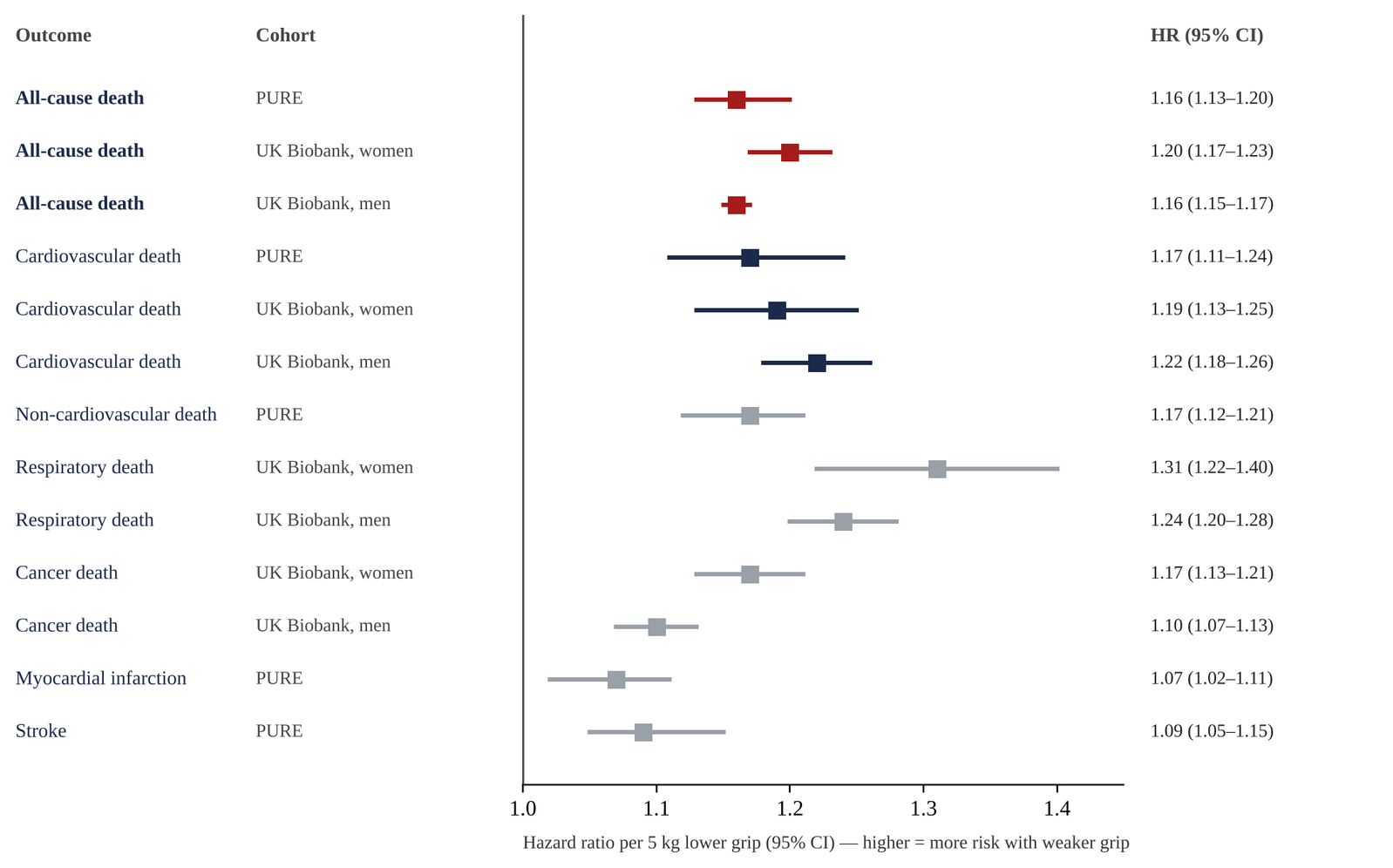
Figure 1. Every 5 kg of lost grip raises the hazard of death by 16–20%. Adjusted hazard ratios per 5 kg lower grip strength. Sources: Leong et al., Lancet 2015 (PURE, n = 139,691); Celis-Morales et al., BMJ 2018 (UK Biobank, n = 502,293).
The PURE study. Leong and colleagues followed 139,691 adults aged 35–70 in 17 countries, from low- to high-income, measuring grip with a Jamar dynamometer. Over a median 4.0 years, 3,379 participants died. Grip strength was a stronger predictor of all-cause and cardiovascular mortality than systolic blood pressure, and the association held in both sexes and all age groups.
UK Biobank. Celis-Morales and colleagues analyzed 502,293 adults aged 40–69 over a mean 7.1 years. Weakness, defined as grip under 26 kg in men and 16 kg in women, carried higher hazard for nearly every outcome studied. Adding grip to an office risk score (age, sex, diabetes, BMI, systolic pressure, smoking) improved the C-index by 0.013 for all-cause and 0.012 for cardiovascular mortality. Notably, hazard ratios were higher in younger age groups, so weakness at 50 is a louder warning than weakness at 75.
Meta-analyses. The pooled evidence is consistent:
- A 2022 dose-response meta-analysis (López-Bueno et al., Ageing Research Reviews) found all-cause risk falls in a close-to-linear fashion across the whole 26–50 kg range. There is no plateau where more strength stops helping.
- An umbrella review (Soysal et al., Journal of Sport and Health Science, 2021) graded the evidence: across 34 studies and 1,855,817 people, higher grip carried a relative risk of death of 0.72. It rated this Class II, “highly suggestive.”
- Bohannon’s 2019 review summarizes three earlier meta-analyses: a pooled categorical hazard ratio of 1.79 (22 articles), 1.16 per 5 kg lower grip (40 studies), and 0.69 for higher versus lower grip (33 studies).
What the numbers mean at the bedside. Hazard ratios compound. A man whose grip is 10 kg below a peer’s carries roughly 1.16 × 1.16 ≈ 1.35 times the hazard of death, about 35% higher, independent of his blood pressure and cholesterol.
Literature Review II: Cardiovascular Disease and Cardiovascular Death
Grip strength predicts cardiovascular death about as strongly as it predicts death from any cause, and it adds prognostic information on top of the risk factors cardiologists already measure. The association is strongest for fatal events and heart failure, and weaker for incident myocardial infarction and stroke (Figure 1).
General populations. In PURE, grip outperformed systolic blood pressure as a predictor of cardiovascular death. In UK Biobank, grip improved the discrimination of an office-based risk score for cardiovascular mortality and incident cardiovascular disease. The Soysal umbrella review found higher grip associated with a relative risk of cardiovascular death of 0.84 across 15 studies, graded “highly suggestive.”
Patients with established heart disease. The signal is louder in the cardiac clinic than in the general population:
- An individual-patient pooled meta-analysis in Heart (2019) of patients with ischemic heart disease, heart failure, cardiomyopathy, valve disease, and arrhythmia found each 5 kg of grip independently predicted cardiac death (OR 0.84), all-cause death (OR 0.87), and heart-failure admission (OR 0.88). It found no relationship with recurrent MI or stroke.
- A 2023 meta-analysis of 15 studies and 7,350 heart-failure patients found each 1 kg decrease in grip raised mortality risk by 8% (RR 1.08), and low grip raised the risk of rehospitalization or death (RR 1.67).
- A 2024 meta-analysis in coronary artery disease found weak grip at baseline nearly doubled all-cause mortality during follow-up (RR 1.95).
Caveats. Not every cohort agrees on cardiovascular endpoints. Bohannon notes one study in which the association held only in men, and another in which it disappeared after adjustment for baseline cardiovascular risk. Grip is best read as a marker of reserve and resilience once disease is present, rather than a driver of atherosclerosis itself.
Literature Review III: Exceptional Longevity and Biological Aging
Midlife grip strength predicts not only who dies early but who reaches 100, and weaker grip tracks with faster biological aging at the level of DNA.
Centenarians. Rantanen and colleagues followed 2,239 Japanese-American men from the Honolulu Heart Program, measured at ages 56–68 in 1965–1968, for 44 years with complete death ascertainment. Compared with men who died at 79 or younger, centenarians were about 2.5 times more likely to have been in the top third of midlife grip strength (OR 2.52). The other predictors were never smoking, leisure-time physical activity, and a long-lived mother. Statistically, the mother’s longevity and the son’s grip appeared to operate through overlapping pathways, suggesting grip partly captures inherited resilience.
Disability decades later. In the same program, a 1999 JAMA study of 6,089 healthy men aged 45–68 found that the lowest grip tertile carried more than twice the risk of self-care disability 25 years later. Adjusting for chronic conditions acquired over follow-up barely changed this. The authors’ interpretation: midlife strength provides a safety margin above the threshold of disability.
The rate of decline. In a 27-year Honolulu follow-up, grip fell by about 1.0% per year on average. Steeper decline, above 1.5% per year, was associated with weight loss, stroke, diabetes, arthritis, coronary disease, and COPD. Men in the lowest baseline tertile had roughly eight times the risk of severe weakness in old age, simply because they started with less reserve.
Epigenetic aging. Peterson and colleagues (J Cachexia Sarcopenia Muscle, 2023) studied 1,274 middle-aged and older adults in the Health and Retirement Study over 8–10 years. Lower grip normalized to body mass, and loss of strength over time, were associated with DNA methylation age acceleration on the DunedinPoAm, PhenoAge, and GrimAge clocks. This is the first molecular bridge between a weak handshake and a faster-aging body, though it remains associational.
Literature Review IV: Metabolic, Cognitive, Skeletal, and Hospital Outcomes
Beyond mortality, low grip strength travels with diabetes, dementia, fractures, and poor outcomes in hospital. Bohannon’s 2019 review concluded that grip is a consistent cross-sectional correlate of overall strength, bone density, falls, malnutrition, cognitive impairment, depression, sleep problems, diabetes, multimorbidity, and quality of life.
Type 2 diabetes. Relative grip (kg per kg body weight) matters more than absolute grip here. In 166,894 UK Biobank participants, the lowest versus highest quintile of relative grip carried more than double the diabetes risk in men (HR 2.22) and 96% higher risk in women (HR 1.96), independent of adiposity. A 2022 meta-analysis found each 5 kg of absolute grip lowered diabetes risk only 5%, but each 0.1 unit of relative grip lowered it 22%.
Dementia. Two UK Biobank analyses point the same way:
- Among 466,788 participants (Esteban-Cornejo et al., 2022), the weakest quintile had 72% higher dementia incidence and 87% higher dementia mortality than the strongest. The authors estimated that about 30% of dementia cases were attributable to low grip.
- In a 190,406-person subsample (Duchowny et al., JAMA Network Open, 2022), each 5 kg decrement was associated with incident dementia (HR 1.20 in men, 1.12 in women), lower fluid intelligence, and greater white-matter hyperintensity volume. The association was most pronounced for vascular dementia, which is the cardiologist’s territory.
Bone, falls, and fractures. Grip is linked to bone mineral density at sites unrelated to the hand, including spine and hip, and strength explains bone density better than muscle mass does. In a systematic review cited by Bohannon, all 11 included studies confirmed a link between weaker grip and hip fracture.
Hospitalization. Weak grip predicts emergency admission, prolonged stay, post-operative complications (including after elective cardiac surgery), and 30-day readmission or death. For the cardiac surgical and heart-failure patient, a pre-procedure grip reading is a cheap frailty screen.
Mechanisms: Why a Handshake Tracks Survival
Grip strength predicts so many outcomes because it summarizes several biological systems at once. As PURE lead author Darryl Leong of McMaster University explained to the BBC, a person’s strength is the sum of their nutrition, physical activity, and illness burden. The plausible pathways:
- Metabolic reservoir. Skeletal muscle is the largest site of insulin-mediated glucose disposal. Less functional muscle means more insulin resistance, which drives diabetes, atherosclerosis, and fatty liver.
- Myokine signaling. Contracting muscle releases signaling proteins with anti-inflammatory and neuroprotective effects. Weak, sedentary muscle loses this signaling, which may help explain the dementia and vascular associations.
- Inflammation and catabolism. Chronic inflammation, occult cancer, heart failure, and COPD all accelerate muscle breakdown. Here weak grip is a consequence of disease rather than a cause, a reverse pathway that matters when interpreting the data.
- Physiological reserve. Muscle is the body’s protein bank in acute illness. Patients who enter pneumonia, surgery, or decompensated heart failure with more muscle have more to spend before they cross the threshold of disability or death.
- Biological aging. Loss of strength tracks with epigenetic age acceleration, suggesting grip partly reads out the pace of systemic aging.
- Behavior. Strong grip usually reflects an active life. Grip is partly a proxy for the cumulative dose of physical activity, which is itself one of the strongest predictors of longevity.
The practical implication: a low grip reading is a prompt to look for disease, malnutrition, and inactivity, not only a reason to prescribe hand exercises.
Reference Values and Cutoffs
Sarcopenia cutoffs mark severe weakness; they are floors, not targets. In the largest normative dataset, Dodds et al. (PLoS One, 2014) pooled 49,964 British participants: median grip peaked at 51 kg in men (ages 29–39) and 31 kg in women (ages 26–42), held through midlife, then declined. By age 80, 23% of men and 27% of women met the definition of weak grip.
| Definition | Purpose | Men | Women |
|---|---|---|---|
| EWGSOP2 (2019) | European sarcopenia standard (current) | < 27 kg | < 16 kg |
| AWGS (2019) | Asian sarcopenia standard (current) | < 28 kg | < 18 kg |
| FNIH Sarcopenia Project | U.S. weakness; used to define weakness in UK Biobank | < 26 kg | < 16 kg |
| Sarcopenia Definition and Outcomes Consortium (2020) | Weakness tied to adverse outcomes | < 35.5 kg | < 20 kg |
| German National Cohort (2023) | Population-derived cutoff, 200,389 adults | < 29 kg | < 18 kg |
| Mortality-sensitive cutoff (ELSI-Brazil) | Identifies mortality risk across sarcopenia status | < 36 kg | < 23 kg |
| EWGSOP1 (2010), superseded | Older European standard, still widely quoted | < 30 kg | < 20 kg |
A note on popular sources. Consumer articles often still quote the superseded EWGSOP1 cutoffs (30/20 kg) and the 2014 Asian cutoffs (26/18 kg) as current. The updated 2019 values are above. Age-banded “healthy ranges” circulating online are approximations; for an individual, compare against Dodds centiles for age and sex, and above all against the patient’s own prior readings.
For a longevity practice, the EWGSOP2 line is too low to be the goal. The dose-response data show mortality falling across the entire 26–50 kg range in men, and the outcome-anchored cutoffs (35.5–36 kg men, 20–23 kg women) catch far more at-risk patients. A reasonable target is at or above the age- and sex-specific median, with no decline over time.
Is the Relationship Causal? Limitations of the Evidence
Grip strength is a proven predictor, but it has not been proven to be a cause of longevity. Every study reviewed here is observational. Honest use of the test requires five cautions:
- Reverse causation. Undiagnosed cancer, heart failure, COPD, and depression all weaken muscle before they are diagnosed. Some of the excess mortality in weak patients reflects disease that was already present. Short follow-up studies are most vulnerable to this.
- Residual confounding. Grip correlates with physical activity, socioeconomic status, smoking, and nutrition. Cohorts adjust for these, but imperfectly measured confounders remain.
- Inconsistent cancer signal. Meta-analyses cited by Bohannon found no significant association between grip and cancer mortality (pooled HRs 0.97 and 1.10), while UK Biobank found one for several cancers but not prostate. The cardiovascular and all-cause signals are far more consistent.
- Measurement heterogeneity. Different dynamometers, postures, and summary statistics limit comparison of absolute values across studies, and cutoffs differ by population.
- Evidence grade. The Soysal umbrella review rated the mortality association Class II, “highly suggestive,” and found no outcome with Class I, “convincing,” evidence.
The PURE authors themselves called for trials testing whether improving strength reduces mortality and cardiovascular disease. That trial has not been done. University of Michigan researcher Mark Peterson has been similarly direct: improving grip strength will not by itself add years to a life already weakened by disease.
Can Grip Strength Be Improved, and Does It Matter?
Grip strength is highly trainable at any age, and the behavior that builds it, whole-body resistance training, independently lowers mortality. What remains unproven is that raising the grip number itself extends life.
Grip responds to training. A network meta-analysis of 42 randomized trials and 3,728 participants (Shen et al., 2023) found resistance training among the most effective interventions, raising grip by a mean 2.69 kg in older adults with sarcopenia. A 2025 dose-response network meta-analysis found the largest gains with training three times per week at moderate intensity (about 50% of one-repetition maximum) for roughly 19 weeks.
Strength training lowers mortality. A 2022 meta-analysis in the British Journal of Sports Medicine (Momma et al., 16 cohort studies) found muscle-strengthening activity associated with 10–17% lower risk of all-cause mortality, cardiovascular disease, total cancer, and diabetes. The maximum benefit came at just 30–60 minutes per week. Combined with aerobic activity, the mortality reduction reached about 40% versus none.
Strength and fitness together. In 70,913 UK Biobank adults free of heart attack, stroke, and cancer, those highest in both cardiorespiratory fitness and grip had roughly half the all-cause mortality and less than a third of the cardiovascular mortality of those lowest in both (HR 0.53 and 0.31). Strength and aerobic fitness are complementary, not interchangeable.
A practical prescription.
- Resistance training for all major muscle groups two to three times per week: rows, pull-downs or pull-ups, deadlifts or trap-bar lifts, farmer’s carries, and leg work.
- Grip-specific additions: dead hangs, farmer’s walks, and towel or thick-handle grips.
- Progressive overload: the last repetitions of each set should be hard but achievable with good form.
- Adequate dietary protein, particularly in older patients, alongside 150 minutes of weekly aerobic activity.
Grip-only devices will raise the dynamometer reading without delivering the whole-body benefit. The goal is a stronger patient, not a stronger forearm.
Clinical Recommendations: Grip Strength as a Vital Sign
Grip strength should be measured at every annual visit in adults over 40, and at baseline before cardiac procedures. In a concierge cardiology practice with a limited panel and longer visits, the marginal cost is about three minutes and a one-time instrument purchase.
Protocol.
- Use one calibrated hydraulic dynamometer (Jamar or equivalent) for the whole panel, so serial values are comparable.
- Follow the seated, elbow-at-90° protocol above: three trials per hand, record the best.
- Chart both absolute grip (kg) and grip per kg of body weight, beside blood pressure and BMI.
- Plot each patient against Dodds age- and sex-specific centiles and against his or her own prior values.
Interpretation and action.
| Finding | Interpretation | Action |
|---|---|---|
| At or above age-sex median, stable | Healthy reserve | Reinforce training; re-measure annually |
| Below median, or relative grip low despite normal kg | Reduced reserve; possible sarcopenic obesity | Prescribe resistance training; review protein intake; re-test in 3–6 months |
| Below outcome-anchored cutoff (men < 36 kg, women < 23 kg) | Elevated mortality risk | Above, plus gait speed and chair-stand test; screen for occult disease, depression, and medication effects |
| Below EWGSOP2 cutoff (men < 27 kg, women < 16 kg) | Probable sarcopenia | Body composition (DEXA or bioimpedance); geriatric and nutrition assessment; structured or supervised exercise |
| Decline > 1.5% per year, or > 5 kg between visits | Accelerated loss | Search for cause: heart failure, malignancy, endocrine disease, inflammation, weight loss, medication effect |
Integration with cardiovascular care.
- In heart-failure and post-MI patients, low grip identifies those most likely to benefit from cardiac rehabilitation with a resistance component.
- Before TAVR, PCI in elderly patients, or cardiac surgery, grip is a quick frailty marker that informs risk discussions.
- Grip adds information to standard risk scores. It is a reason to intensify prevention, not a substitute for lipids, blood pressure, or imaging.
Patient communication. Patients understand grip intuitively. Showing a patient his number, his centile, and his trend over time is one of the most motivating conversations a physician can have about exercise.
Summary and Recommendations for Every Patient
What the Evidence Shows
Grip strength is one of the best-validated, least expensive predictors of how long a person will live. The literature reviewed here supports six conclusions:
- Mortality. Across more than 640,000 adults in PURE and UK Biobank alone, each 5 kg of lost grip raises the hazard of death by about 16–20%, in men and women and at every age studied.
- Cardiovascular risk. In PURE, grip predicted cardiovascular death better than systolic blood pressure, and in UK Biobank it improved a standard office risk score. In patients who already have heart disease, weak grip predicts cardiac death and heart-failure admission.
- Longevity and aging. Midlife grip predicts who will reach 100, who will be disabled 25 years later, and whose DNA is aging faster.
- Whole-body health. Weak grip travels with type 2 diabetes, dementia (especially vascular dementia), fractures, and complications in hospital.
- No ceiling. Mortality risk falls almost continuously across the 26–50 kg range. Stronger is better, with no point where more strength stops helping.
- Causation unproven, action justified. All of this evidence is observational. But the behaviors that build strength, resistance training, aerobic fitness, and good nutrition, are independently associated with lower mortality, and the test itself costs almost nothing.
The Handshake as a Clinical Sign
The handshake is the oldest strength test in medicine, and every physician already performs it. McMaster University physician Guillaume Paré has described a handshake in which the fingers cannot close around the examiner’s hand, or in which the small muscles of the hand are visibly wasted, as a red flag for sarcopenia. A weak handshake should prompt a dynamometer reading; the dynamometer turns an impression into a number that can be charted, compared with population norms, and followed over time.
Ten Recommendations for Every Patient
- Know your number. Have grip strength measured once a year from age 40, on the same device and with the same protocol. Aim to be at or above the median for your age and sex, and above all to show no year-over-year decline.
- Lift weights two to three days a week. Train all major muscle groups: legs, hips, back, chest, shoulders, and arms. Use loads that make the last few repetitions of each set hard but achievable with good form. The Physical Activity Guidelines for Americans call for muscle-strengthening activity at least two days a week, and the largest mortality benefit in cohort studies appears at only 30–60 minutes per week.
- Train the grip directly. Finish two or three sessions a week with grip work: dead hangs from a bar, farmer’s carries with dumbbells, thick-handle or towel grips, wrist curls, and timed tennis-ball squeezes.
- Pair strength with aerobic fitness. Accumulate 150–300 minutes of moderate activity, such as brisk walking or cycling, or 75–150 minutes of vigorous activity each week. Strength and aerobic activity combined were associated with roughly 40% lower mortality than neither, and people high in both fitness and grip had about half the mortality of those low in both.
- Eat enough protein, spread across the day. The PROT-AGE expert group recommends at least 1.0–1.2 g of protein per kg of body weight per day for healthy adults over 65, 1.2 g/kg or more for those who exercise, and 1.2–1.5 g/kg during acute or chronic illness. Patients with severe kidney disease not on dialysis need an individualized limit instead.
- Protect muscle when losing weight. Any weight-loss plan, whether by diet, medication, or surgery, should include resistance training and adequate protein, with grip rechecked along the way. Weight lost as muscle undermines the very reserve this paper describes.
- Move throughout the day. Break up long periods of sitting with walking, stairs, yard work, and carrying groceries. Grip is partly a record of lifelong activity.
- Sleep and recover. Aim for 7–9 hours a night. Poor sleep quality is associated with lower grip strength, and muscle is rebuilt during recovery, not during the workout.
- Treat what steals muscle. Keep diabetes, heart failure, lung disease, depression, and inflammatory conditions well controlled. Report unexplained weakness, a falling grip reading, or unintended weight loss promptly; these can be early signs of disease.
- Build balance after 65. Older adults should combine strength, aerobic, and balance training, as the federal guidelines recommend. Tai chi, single-leg stands, and chair-rise practice reduce fall risk and preserve independence.
Adjusting the Prescription by Age
| Age | Priority | Practical focus |
|---|---|---|
| 40–59 | Build reserve | Establish a baseline grip; progressive whole-body lifting; aerobic base; treat metabolic risk factors early |
| 60–74 | Maintain strength and slow the roughly 1% yearly decline | Lifting two to three days a week; protein at 1.0–1.2 g/kg or more; add balance work; annual grip check |
| 75 and older | Preserve independence | Supervised or guided program; chair-based options if needed; fall prevention; nutrition and medication review |
Safety for Patients with Heart Disease
- Patients with known cardiovascular disease should be cleared by their physician before starting resistance training, and those recovering from MI, cardiac surgery, or heart-failure hospitalization should begin in a cardiac rehabilitation program.
- Use moderate loads and more repetitions at first. Breathe out during the effort and avoid breath-holding (the Valsalva maneuver), which sharply raises blood pressure.
- Stop and seek care for chest pain, unusual shortness of breath, dizziness, or palpitations.
- Defer resistance training until stabilized in uncontrolled hypertension, unstable angina, decompensated heart failure, or severe symptomatic aortic stenosis.
Closing
It is not yet proven that raising grip strength extends life. But the behavior that raises it, regular whole-body resistance training, is independently associated with lower mortality, and the measurement itself costs almost nothing. That combination makes grip strength, and the handshake that first reveals it, an indispensable biomarker for any practice devoted to longevity. The strength in a patient’s hand is, quite literally, a measure of the reserve in the rest of the body.
References
- Leong DP, Teo KK, Rangarajan S, et al. Prognostic value of grip strength: findings from the Prospective Urban Rural Epidemiology (PURE) study. Lancet. 2015;386(9990):266–273.
- Celis-Morales CA, Welsh P, Lyall DM, et al. Associations of grip strength with cardiovascular, respiratory, and cancer outcomes and all cause mortality: prospective cohort study of half a million UK Biobank participants. BMJ. 2018;361:k1651.
- Bohannon RW. Grip strength: an indispensable biomarker for older adults. Clin Interv Aging. 2019;14:1681–1691.
- López-Bueno R, Andersen LL, Koyanagi A, et al. Thresholds of handgrip strength for all-cause, cancer, and cardiovascular mortality: a systematic review with dose-response meta-analysis. Ageing Res Rev. 2022;82:101778.
- Soysal P, Hurst C, Demurtas J, et al. Handgrip strength and health outcomes: umbrella review of systematic reviews with meta-analyses of observational studies. J Sport Health Sci. 2021;10(3):290–295.
- Pavasini R, Serenelli M, Celis-Morales CA, et al. Grip strength predicts cardiac adverse events in patients with cardiac disorders: an individual patient pooled meta-analysis. Heart. 2019;105(11):834–841.
- Handgrip strength and the prognosis of patients with heart failure: a meta-analysis. Clin Cardiol. 2023. doi:10.1002/clc.24063.
- Association between handgrip strength and mortality of patients with coronary artery disease: a meta-analysis. Clin Cardiol. 2024. doi:10.1002/clc.24322.
- Rantanen T, Masaki K, He Q, et al. Midlife muscle strength and human longevity up to age 100 years: a 44-year prospective study among a decedent cohort. Age. 2012;34(3):563–570.
- Rantanen T, Guralnik JM, Foley D, et al. Midlife hand grip strength as a predictor of old age disability. JAMA. 1999;281(6):558–560.
- Rantanen T, et al. Grip strength changes over 27 years in Japanese-American men. J Appl Physiol. 1998.
- Peterson MD, Collins S, Meier HCS, Brahmsteadt A, Faul JD. Grip strength is inversely associated with DNA methylation age acceleration. J Cachexia Sarcopenia Muscle. 2023;14(1):108–115.
- Esteban-Cornejo I, Ho FK, Petermann-Rocha F, et al. Handgrip strength and all-cause dementia incidence and mortality: findings from the UK Biobank prospective cohort study. J Cachexia Sarcopenia Muscle. 2022;13(3):1514–1525.
- Duchowny KA, Ackley SF, Brenowitz WD, et al. Associations between handgrip strength and dementia risk, cognition, and neuroimaging outcomes in the UK Biobank cohort study. JAMA Netw Open. 2022.
- Boonpor J, Parra S, Petermann-Rocha F, et al. Associations between grip strength and incident type 2 diabetes: findings from the UK Biobank prospective cohort study. BMJ Open Diabetes Res Care. 2021;9:e001865.
- Association between handgrip strength and type 2 diabetes: a prospective cohort study and systematic review with meta-analysis. J Gerontol A Biol Sci Med Sci. 2022.
- Dodds RM, Syddall HE, Cooper R, et al. Grip strength across the life course: normative data from twelve British studies. PLoS One. 2014;9(12):e113637.
- Roberts HC, Denison HJ, Martin HJ, et al. A review of the measurement of grip strength in clinical and epidemiological studies: towards a standardised approach. Age Ageing. 2011;40(4):423–429.
- Cruz-Jentoft AJ, et al. Sarcopenia: revised European consensus on definition and diagnosis (EWGSOP2). Age Ageing. 2019.
- Chen LK, et al. Asian Working Group for Sarcopenia: 2019 consensus update on sarcopenia diagnosis and treatment. J Am Med Dir Assoc. 2020.
- Low grip strength cut-off points from the German National Cohort (NAKO) compared with EWGSOP2. 2023.
- How does the cut-off point for grip strength affect the prevalence of sarcopenia and associated factors? Findings from the ELSI-Brazil study.
- Momma H, Kawakami R, Honda T, Sawada SS. Muscle-strengthening activities are associated with lower risk and mortality in major non-communicable diseases: a systematic review and meta-analysis of cohort studies. Br J Sports Med. 2022;56(13):755–763.
- Kim Y, et al. The combination of cardiorespiratory fitness and muscle strength, and mortality risk. Eur J Epidemiol. 2018;33(10):953–964.
- Li HR, Huang S, Yv Z, et al. Optimal dose of resistance training to improve handgrip strength in older adults with sarcopenia: a systematic review and Bayesian model-based network meta-analysis. Front Physiol. 2025;16:1564988.
- Piercy KL, Troiano RP, Ballard RM, et al. The Physical Activity Guidelines for Americans. JAMA. 2018;320(19):2020–2028.
- Bauer J, Biolo G, Cederholm T, et al. Evidence-based recommendations for optimal dietary protein intake in older people: a position paper from the PROT-AGE Study Group. J Am Med Dir Assoc. 2013;14(8):542–559.