
Aortic Dissection, the Cost of Misdiagnosis, and the Case for Proactive Screening
Chauncey W. Crandall IV, MD, FACC, FACP
Crandall Concierge Medicine & Cardiology
1411 N Flagler Dr., Suite 3902 · Farris Building ∙ Good Samaritan Medical Center
West Palm Beach, Florida 33401
September 2026
In memory of John Ritter (1948–2003) and Sen. Lindsey Graham (1955–2026)
Executive Summary
Aortic dissection is one of the few true minute-to-minute emergencies in cardiovascular medicine, and it is also one of the most frequently missed. It announces itself with chest, back, or abdominal pain that overlaps so closely with a heart attack that emergency physicians reach for the wrong diagnosis in an estimated one out of every four to seven cases. The consequence of that error is rarely neutral: the anticoagulants, antiplatelet agents, and thrombolytics used to treat a suspected myocardial infarction are precisely the wrong medicines for a torn aorta, and they can convert a survivable dissection into a fatal one.
Two recent, very public deaths frame the two faces of this disease. John Ritter, the actor, died in 2003 at 54 after being treated for a heart attack he did not have; his family’s account of that night, and their subsequent advocacy through the John Ritter Foundation for Aortic Health, has become a touchstone for the danger of anchoring on the common diagnosis. Sen. Lindsey Graham died in July 2026 at 71 of an aortic dissection attributed by the District of Columbia medical examiner to arteriosclerotic cardiovascular disease — a reminder that the degenerative, hypertension- and atherosclerosis-driven pathway to aortic catastrophe remains as lethal as the inherited one, and often gives even less warning.
This paper reviews the pathophysiology, epidemiology, genetics, and diagnostic pitfalls of aortic dissection against the current academic literature, uses the Ritter and Graham cases as illustrative bookends of the heritable and degenerative pathways, and sets out a practical framework — family-history screening, imaging surveillance, and a low threshold for aortic imaging in atypical chest pain — that a proactive, high-touch practice model is well positioned to deliver.
I. Anatomy of a Silent Killer
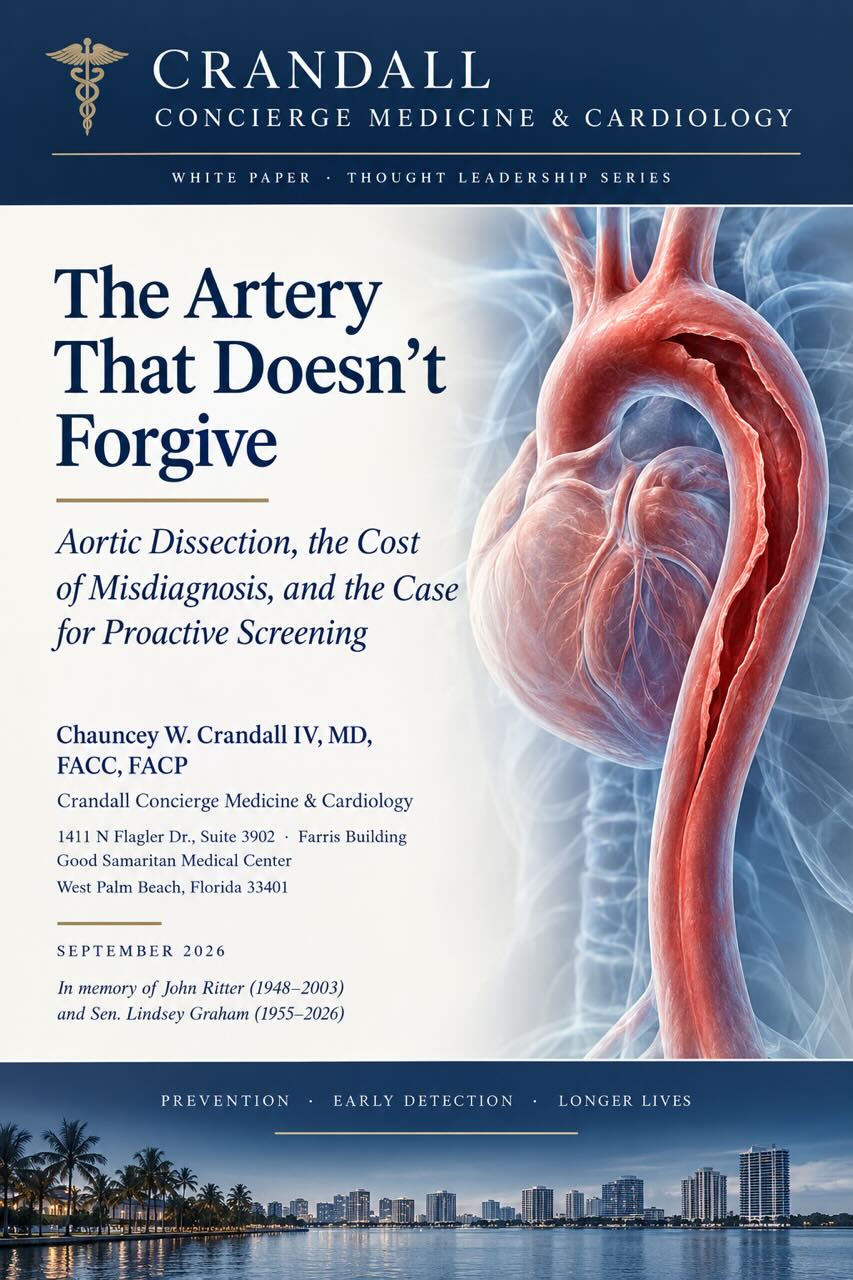
The aorta is a three-layered vessel — intima, media, and adventitia — that carries the entirety of the heart’s output. An aortic dissection begins when a tear opens in the innermost layer, allowing pressurized blood to force its way between the intima and the media and create a second, false channel alongside the true lumen. As that false lumen propagates, it can shear off the blood supply to the coronary arteries, the brain, the spinal cord, the kidneys, or the limbs; rupture through the adventitia into the pericardial sac produces cardiac tamponade, the single most common cause of death in dissections involving the ascending aorta.
Dissections are classified by the Stanford system into Type A, involving the ascending aorta and arch, and Type B, confined to the descending aorta beyond the left subclavian artery — a distinction that matters because Type A is a surgical emergency, while uncomplicated Type B is usually managed medically. The DeBakey system (Types I, II, and III) further subdivides by the extent of involvement. Registry data place in-hospital mortality for untreated Type A dissection at roughly 27% to 58%, against approximately 11% for Type B — and the oldest clinical teaching in the field, that untreated Type A mortality climbs by one to two percent for every hour that passes without repair, has held up under modern registry scrutiny even as contemporary surgical outcomes have improved substantially.
II. Two Deaths, Two Lessons
A. John Ritter — When the Common Diagnosis Is the Wrong One
John Ritter collapsed at a Burbank hospital in September 2003 with chest pain, sweating, and vomiting — a presentation clinicians reasonably associated with acute coronary syndrome, particularly given a family history the Ritters describe as generations of men who “died of their first and last heart attack.” He was treated as a cardiac patient: blood thinners were given and a cardiac catheterization was performed before imaging identified the true problem, a massive aortic dissection. By the family’s account and their subsequent wrongful-death litigation, a chest X-ray taken earlier in the encounter could have raised suspicion of an enlarged aorta and redirected the workup toward definitive surgery. Ritter died at 54.
The Ritter family’s retrospective view — that Tex Ritter’s own sudden cardiac death decades earlier may itself have been an undiagnosed dissection rather than a heart attack — illustrates a recurring theme in the heritable aortopathies: a family narrative of “heart trouble” or sudden death can be, on closer genealogical and clinical review, a story about the aorta rather than the coronary arteries. Following John Ritter’s death, his surviving children began annual aortic imaging, and his older brother Tom underwent aortic root and repair surgery after routine surveillance detected a previously unrecognized aneurysm — a sequence that is itself a small, informal demonstration of the guideline-recommended cascade: index case, family-history review, and imaging of first-degree relatives.
An aortic dissection can be, and often is, treated for the far more common thing it resembles — before imaging says otherwise. — consistent with the diagnostic-delay literature reviewed below
B. Lindsey Graham — The Degenerative Pathway Kills Just as Fast
Sen. Lindsey Graham died on the evening of July 11, 2026, after a brief illness that began with chest pain and cardiac arrest; he was 71. The District of Columbia medical examiner’s preliminary finding attributed the dissection to arteriosclerotic cardiovascular disease — that is, a wall weakened by long-standing atherosclerosis and, presumably, the cumulative burden of blood pressure rather than an identified inherited connective-tissue or aortopathy syndrome. Unlike Ritter, there is no public suggestion of a Marfan-spectrum or familial aortic disorder in Graham’s case; his death instead represents the more common route to aortic catastrophe in the general population — hypertensive and atherosclerotic degeneration of the aortic wall over decades, which can produce an aneurysm or a frank dissection with little or no antecedent warning.
Graham’s death, in a man with none of the syndromic features that typically prompt genetic suspicion, underscores a point the heritable-aortopathy literature makes explicitly: a family history is the single most useful and most under-used screening tool, but it is not the only route to this disease, and routine, unglamorous risk factors — blood pressure control chief among them — remain the dominant modifiable driver of aortic wall failure in the broader population.
Two Pathways to the Same Catastrophe
| Feature | John Ritter (2003) | Lindsey Graham (2026) |
|---|---|---|
| Predominant mechanism | Suspected heritable/connective-tissue vulnerability of the aortic wall, occurring in a family with a pattern of early cardiac or sudden death | Degenerative wall injury from long-standing atherosclerosis and hypertension |
| Age at death | 54 | 71 |
| Diagnostic course | Initially treated as myocardial infarction; dissection found intraoperatively during catheterization | Presented with chest pain and cardiac arrest; cause established by medical examiner post-mortem |
| Family-history signal | Multi-generational pattern of presumed cardiac sudden death later reinterpreted by the family as possible aortic disease | No public history of a familial aortopathy |
| Principal lesson | A textbook mimic of acute coronary syndrome can still be missed even in a monitored hospital setting | Atherosclerotic aortic disease can be rapidly fatal even without a syndromic or familial warning sign |
III. Why Aortic Dissection Is So Often Missed
The academic literature is remarkably consistent on this point: aortic dissection is misdiagnosed in a substantial minority of cases, with reported rates ranging from roughly 14% to 38% across case series, because its presentation overlaps with acute coronary syndrome, pulmonary embolism, pericarditis, and even acute abdominal disease. One frequently cited analysis found that the strongest single predictor of a missed diagnosis was simply arriving as a walk-in rather than by ambulance, alongside anterior chest pain, severe or “worst pain of my life” quality, and a widened mediastinum on chest X-ray that was not acted upon.
A 2026 case report from Kettering General Hospital in the United Kingdom is illustrative of how this plays out even in a modern hospital: a 53-year-old man with hypertension presented with central chest pain and ECG changes consistent with an inferior ST-elevation myocardial infarction, was taken for cardiac catheterization, and the dissection was discovered only when the interventional cardiologist could not engage the right coronary artery — at which point a bedside echocardiogram confirmed a Type A dissection extending from the aortic root to the abdominal aorta. The patient arrested during the procedure and was resuscitated, but suffered a complicated postoperative course including multiple strokes. A separate 2025 case series documented a fatal outcome after a patient with a genuine coexisting myocardial infarction underwent coronary stenting before the aortic dissection driving his instability was recognized.
The clinical stakes of this overlap are high in a specific way: the standard treatments for suspected acute coronary syndrome — antiplatelet agents, anticoagulants, and thrombolytics — are directly harmful in dissection, increasing the risk of bleeding into the false lumen and precipitating cardiac tamponade, which registry data identify as the leading cause of death in proximal dissection. This is the precise mechanism the Ritter family’s litigation alleged in 2003, and it remains a documented failure mode in the literature more than two decades later.
Registry-level mortality data reinforce the urgency. The International Registry of Acute Aortic Dissection (IRAD), a consortium founded in 1996 and now spanning more than two dozen referral centers worldwide, followed over 5,600 Type A dissection patients from 1996 to 2018 and found 48-hour mortality of roughly 24% in medically managed patients versus 4.4% in those treated surgically — a more than five-fold difference that hinges entirely on timely recognition. Older teaching that untreated Type A mortality rises 1% to 2% per hour has proven durable across decades of registry analysis, even as overall outcomes have improved with modern imaging and surgical technique.
IV. The Heritable Pathway: Genetics and Family Screening
A meaningful share of thoracic aortic disease clusters in families. Current estimates suggest that as many as one in five patients with a thoracic aortic aneurysm or dissection has a first- or second-degree relative with the same condition, and researchers have now linked aortic disease to variants across roughly a dozen genes, with the list still growing. Syndromic forms — Marfan syndrome (FBN1), Loeys-Dietz syndrome (TGFBR1/2 and related genes), and vascular Ehlers-Danlos syndrome (COL3A1) — present with recognizable physical features that can prompt earlier suspicion. Non-syndromic heritable thoracic aortic disease is harder to catch clinically because affected individuals often look entirely healthy until the vessel fails.
The 2022 American College of Cardiology/American Heart Association aortic disease guideline, still the operative standard as of this writing, recommends genetic testing for patients with thoracic aortic aneurysm who have any of several “red flag” features: dilation at an unexpectedly young age, syndromic features, or a family history of aortic disease or unexplained early sudden death in a first- or second-degree relative. Critically, the guideline also directs that first-degree relatives of anyone diagnosed with an aortic root or ascending aneurysm, or with a dissection, undergo aortic imaging — a recommendation the Ritter family effectively adopted on their own initiative, with a documented result: Tom Ritter’s aneurysm was found and repaired before it could rupture.
Genetic testing in this population is a useful but incomplete tool. Contemporary series report a diagnostic yield of roughly 20%, meaning a negative result does not rule out heritable disease and does not, by itself, release at-risk relatives from ongoing imaging surveillance. Where a causative variant is identified, it can still meaningfully guide care — informing the choice and dosing of blood-pressure medication, defining which vascular territories need periodic imaging, and, in several well-characterized genes, lowering the diameter threshold at which prophylactic surgery is recommended relative to degenerative aneurysm disease.
V. The Degenerative Pathway: Hypertension, Atherosclerosis, and Age
Most thoracic aortic aneurysms and dissections in the general population are not attributable to an identified single-gene disorder. Chronic, poorly controlled hypertension imposes sustained wall stress on the aorta; atherosclerosis independently stiffens and weakens the vessel wall; and the combination compounds with age, as reflected in population data showing thoracic aneurysm incidence rising roughly threefold from the mid-twentieth century to the 1990s alongside increasing life expectancy and cardiovascular risk-factor prevalence. This is almost certainly the operative pathway in Sen. Graham’s death, and it is the pathway a general concierge cardiology population will encounter far more often than a syndromic aortopathy.
Other acquired risk factors identified in the literature include chest trauma, stimulant and illicit drug use (particularly cocaine, through acute hypertensive surges), and — independent of genetics — a bicuspid aortic valve, which is present in a meaningful minority of the population and carries its own, non-Mendelian association with ascending aortic dilation.
VI. A Practical Recognition Framework: STAT
The John Ritter Foundation for Aortic Health, founded by Ritter’s widow and family after his death, promotes a four-part mnemonic for both clinicians and patients that condenses the diagnostic literature into an actionable sequence:
- Suspect — maintain a high index of suspicion for sudden, severe “tearing” or “ripping” chest, back, neck, or abdominal pain, especially with a pulse or blood-pressure differential between limbs, or new neurologic deficit.
- Time — treat the encounter as a race against the hour; do not defer imaging while trialing empiric anti-ischemic therapy in a patient whose presentation does not fit cleanly.
- Aortic imaging — CT angiography remains the emergency-department gold standard for diagnosis and surgical planning; point-of-care transthoracic echocardiography, as multiple recent case reports demonstrate, can identify a Type A dissection at the bedside when CT is not immediately available and can resolve the diagnosis mid-catheterization if coronary engagement proves unexpectedly difficult.
- Talk — document and share family history proactively, both with patients’ relatives and across the care team, since a known or suspected familial pattern should itself lower the threshold for imaging in an ambiguous presentation.
This framework maps directly onto findings from the diagnostic-delay literature reviewed above: walk-in presentation, atypical pain description, and an unexamined or unacted-upon mediastinal finding were the recurring threads in missed cases. A structured prompt to “suspect and image” before committing to antithrombotic therapy is the single highest-yield intervention the literature supports.
VII. Implications for a Proactive, Concierge Cardiology Practice
A high-touch, low-volume practice model is structurally well suited to close the exact gap this literature identifies, because the interventions that prevent a missed dissection or an unheralded rupture are time- and relationship-intensive in a way that a high-volume practice or a single emergency-department encounter cannot easily replicate.
- Take a genuine multigenerational family history at intake — not only for coronary disease, but explicitly for sudden death, “heart attacks” in relatives who were never catheterized, known aneurysms, and connective-tissue features — and revisit it periodically rather than treating it as a one-time intake checkbox.
- Apply the ACC/AHA red-flag criteria systematically: offer genetic evaluation and aortic imaging referral to patients with a qualifying family history or syndromic features, and extend imaging recommendations to first-degree relatives once an index case is identified.
- Maintain a low threshold for aortic imaging in patients with hypertension, known aneurysm, bicuspid aortic valve, or a personal or family aortic history who present with atypical, severe, or migratory chest, back, or abdominal pain — rather than proceeding directly to an anti-ischemic pathway.
- Treat blood-pressure control as aortic-protective, not only cardiac-protective, counseling — particularly relevant in a patient population, like Sen. Graham’s age cohort, where degenerative rather than syndromic aortic disease predominates.
- Where genetic testing is pursued, set expectations accurately: a negative result does not end surveillance, and a positive result should directly inform imaging frequency, medication choice, and surgical threshold, per the specific gene identified.
VIII. Conclusion
Aortic dissection kills through two distinct routes that converge on the same catastrophic endpoint: a heritable vulnerability of the vessel wall, as the Ritter family’s history and subsequent surveillance suggest, and a degenerative one, built over decades of blood pressure and atherosclerotic burden, as Sen. Graham’s death illustrates. Both are underdiagnosed because both mimic more common disease, and both are made survivable by the same two things — a clinician willing to suspect the aorta before the more familiar diagnosis, and a system of family-history-driven surveillance that catches the disease before it presents at all. Twenty-three years separate John Ritter’s death from Lindsey Graham’s, and the underlying biology, the diagnostic pitfalls, and the mortality curve after symptom onset have changed remarkably little in that time. What has changed is the evidence base for exactly what to do about it — a body of literature that a proactive practice is positioned to act on immediately, rather than after the fact.
References
Beard, M. “John Ritter’s family warns about the hidden but treatable heart condition that killed him.” New York Post, September 17, 2026.
Baidebettu, G.P., Helal, A., El-din, M., Antoun, I. “Aortic Dissection Mimicking Myocardial Infarction: The Diagnostic Value of Point-of-Care Echocardiography.” Cureus, January 24, 2026. DOI: 10.7759/cureus.102217.
Wang, D., et al. “Diagnostic dilemmas in acute type A aortic dissection with acute myocardial infarction: A fatal misdiagnosis case and improvement strategies.” Medicine, November 2025.
Wang, D., Zhang, L.L., Wang, Z.Y., Zhang, Z.Y., Wang, Y. “The missed diagnosis of aortic dissection in patients with acute myocardial infarction: a disastrous event.” Journal of Thoracic Disease 2017; 9(7): E636–E639.
Case series (sub-Saharan African cohort). “Acute type A aortic dissection involving the iliac and left renal arteries, misdiagnosed as myocardial infarction.” PMC6002801.
Rampoldi, V., et al., for the IRAD investigators. “IRAD experience on surgical type A acute dissection patients: results and predictors of mortality.” Annals of Cardiothoracic Surgery.
Fanola, C., et al., for the IRAD investigators. “Early Mortality in Type A Acute Aortic Dissection: Insights From the International Registry of Acute Aortic Dissection.” JAMA Cardiology; summarized by CTSNet and Vascular News.
Strauss, C.E., et al. Minneapolis Heart Institute Foundation / IRAD analysis presented at the American College of Cardiology Scientific Sessions, 2013 (mortality ~1%/hour, Type A dissection).
2022 ACC/AHA Guideline for the Diagnosis and Management of Aortic Disease, summarized via StatPearls/NCBI Bookshelf, updated June 2024.
Genetic Education Canada. “Heritable Thoracic Aortic Disease” deep-dive guidance document, July 2024.
Patil, R., Ashraf, F., Abu Dayeh, S., Prakash, S.K. “Development and Assessment of a Point-of-Care Application (Genomic Medicine Guidance) for Heritable Thoracic Aortic Disease.” JMIR, October 8, 2024. DOI: 10.2196/55903.
“Precision Medicine in Heritable Thoracic Aortic Disease (HTAD): From Molecular Mechanisms to Genotype-Driven Risk Stratification and Timing of Intervention.” Cardiogenetics, 2025. DOI: 10.3390/cardiogenetics16030017.
“Current understanding of the genetics of thoracic aortic disease.” PMC12058223, 2024.
“Genetically Triggered Thoracic Aortic Disease: Who Should be Tested?” PMC10000331.
Reuters, Associated Press, Bloomberg Law, and District of Columbia Office of the Chief Medical Examiner reporting on the death of Sen. Lindsey Graham, July 11–13, 2026.