What Anthropology Teaches Medicine About Seeing the Whole Patient
Chauncey W. Crandall IV, M.D., FACC, FACP
Concierge Medicine & Cardiology
1411 North Flagler Dr.∙ Suite 3902, Farris Building∙ West Palm Beach, Florida 33401
A growing body of medical literature has documented something most practicing physicians already sense from the inside: the physical examination, once the defining skill of the clinician, is eroding. Multiple studies across internal medicine training programs have found measurable declines in physical exam proficiency among residents and attendings alike, with cardiopulmonary examination skills in particular shown to peak during medical school and decline steadily through residency and beyond. Researchers attribute the trend to a combination of causes: heavier reliance on imaging and laboratory technology, the disappearance of bedside teaching as a formal part of training, and the same structural time pressure that now compresses the average patient encounter into a matter of minutes.
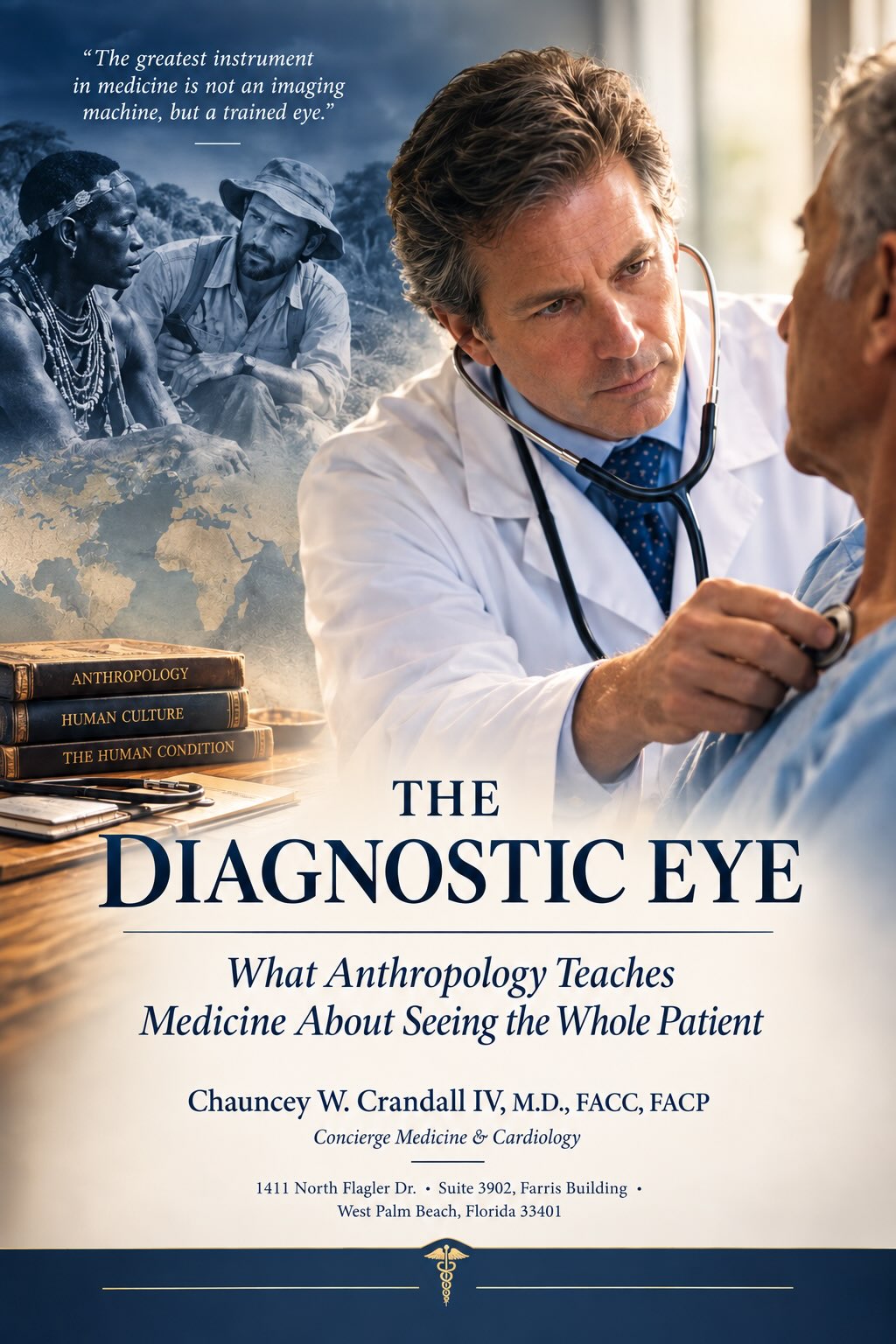
This white paper argues that the decline is not simply a technical skill gap. It is the loss of a discipline — the trained capacity to observe a human being closely enough to see what has not yet been said, tested, or imaged. I make this argument as a board-certified cardiologist with more than 40,000 procedures behind me, but the discipline itself was not first taught to me in medical school. It was taught to me in anthropology, under four mentors who trained me to observe human beings before I ever learned to examine a patient — and it was tested for decades afterward in clinical settings where imaging and laboratory support did not exist at all.
THE DOCUMENTED DECLINE
The erosion of bedside skill is well established in the clinical literature, not merely anecdotal. Reviews in the field of diagnostic medicine describe a decline in physical exam proficiency driven by increased reliance on technology, reduced bedside teaching, and time constraints on the modern encounter. A curriculum study of internal medicine interns noted plainly that physicians now spend less time at the bedside, contributing to a measurable decline in physical diagnosis — particularly cardiopulmonary examination — and identified this as a source of diagnostic error in its own right. Investigators have also found that physical exam skills tend to peak during medical school itself and decline progressively through residency and independent practice, precisely the years in which time pressure and technological dependence both intensify.
The consequences are not abstract. Physical examination findings directly affect patient outcomes, and a well-conducted history alone has been shown to yield sixty to eighty percent of the information required for diagnosis, leading to a final diagnosis in more than seventy percent of cases before any test is ordered. One physician-educator, writing on the decline of bedside skill, observed that technology unguided by clinical observation often leads physicians down a path where tests beget further tests — with a specialist, and often a great deal of unnecessary intervention, waiting at the end of it.
The explosion of imaging and laboratory testing has, in the words of one recent analysis, inverted the diagnostic paradigm — physicians now often encounter an image of the patient before they encounter the patient.
AN OLDER TRAINING IN OBSERVATION
Long before I treated a single patient, I was trained — formally and rigorously — in a discipline built entirely around observation, with no instrument to fall back on. Before medical school, I earned a degree in anthropology and served as research assistant to Dr. Colin Turnbull, the Oxford-trained anthropologist renowned for his fieldwork among the Mbuti Pygmies of Central Africa. Turnbull did not study a people by interrogating them. He watched, patiently and at length, and let the pattern of a life declare itself — a method that depends entirely on the observer’s trained attention, because there is no other instrument available.
I went on to work with Dr. Thomas Larson, a former Peace Corps officer and State Department official with a doctorate in anthropology, traveling to Togo, West Africa, to study the Kabre people and document the methods of traditional healers who diagnosed illness with no imaging, no laboratory, and no tool beyond trained eyes and inherited knowledge passed down through generations. With Dr. Errett Callahan, an experimental archaeologist at the Medical College of Virginia, I conducted research on the Pamunkey Indian Reservation into traditional medicine and tool-making practices, learning that sustained, careful observation is what allows an outside eye to recognize a considered solution where a hurried one sees only unfamiliarity. And under Dr. Richard Snell, one of the foremost anatomists of his generation, I spent a year in the anatomy laboratory in Washington, D.C., learning the physical structure that every clinical finding — a murmur, a skin change, an asymmetry — ultimately traces back to.
Each of these mentors trained the same underlying skill that the clinical literature now identifies as being lost: the discipline of close, unhurried observation, practiced as a method rather than treated as an innate talent some clinicians happen to have and others do not.
TESTED WITHOUT INSTRUMENTS
That discipline was not left in the field notebook. Over three decades, I have practiced medicine in mission hospitals and clinics throughout the Third World, in cholera camps in Haiti, amid hurricane devastation in Jamaica, and in the aftermath of the Haitian earthquake — environments with no imaging, no laboratory turnaround, and frequently no time at all. Fifteen years of travel to the plains of Africa reinforced the same lesson in setting after setting: where instruments disappear, the physician’s trained eye is what remains, and it is either sharp enough to find the diagnosis or it is not.
This is not a case against technology. It is a case that technology was built to extend observation, not replace it — and that when training and workflow stop cultivating the underlying skill, the technology has nothing left to extend. The literature’s own diagnosis of the problem — less bedside time, less bedside teaching, more deference to the image and the lab value — describes the erosion of exactly the capacity that field medicine, and anthropological training before it, require by necessity.
RESTORING THE DISCIPLINE
If the decline in physical examination skill is driven substantially by time pressure and the disappearance of unhurried bedside practice, as the literature suggests, then the remedy is structural as much as educational. A practice model built around a limited patient panel and an unhurried encounter does not merely improve the patient experience — it restores the precondition under which observation, as a diagnostic discipline, can be exercised at all.
At my Concierge Medicine & Cardiology practice in Palm Beach Florida, that structural restoration of time is paired with a lifetime of training in how to use it — anthropological training in observing whole human beings, decades of clinical experience across more than 40,000 cardiac procedures, and field experience reading a patient’s condition when no instrument was available to do it for me. The clinical literature has identified what is being lost. My own training and field record describe what it looks like to keep it.
SOURCES
- Restrepo J, Henriquez R, Torre D, Graber M. “The physical exam and telehealth: between past and future.” Diagnosis. 2024;11(1):1–3.
- Advancing Bedside Cardiopulmonary Examination Skills (ACE) curriculum study, internal medicine postgraduate training program, National Library of Medicine / PMC.
- “The Decline Of Physical Examination Skills In Internal Medicine: An Existential Threat?” GlobalRPH, 2026.
- “The decline of clinical skills: a challenge for medical schools.” National Library of Medicine / PMC (history-taking yield and diagnostic-error data).
- “Is Physical Exam a Lost Art? A Resident’s Perspective.” Journal of General Internal Medicine, Springer Nature Link, 2025.
- Patel et al., as cited in “Is Physical Exam a Lost Art?” — technology-driven erosion of exam skill across physician generations.
- KFF Health News / Medscape, “Patients Lose When Doctors Can’t Do Good Physical Exams,” interviews with Steven McGee (Univ. of Washington) and Salvatore Mangione (Jefferson Medical College).