
How Internet Platforms, Hospital Empires, University Brands, and Wall Street Medicine Manufacture the Appearance of Excellence
The public has been conditioned to believe that internet physician ratings represent an honest measurement of medical quality. In many cases, they do nothing of the kind.
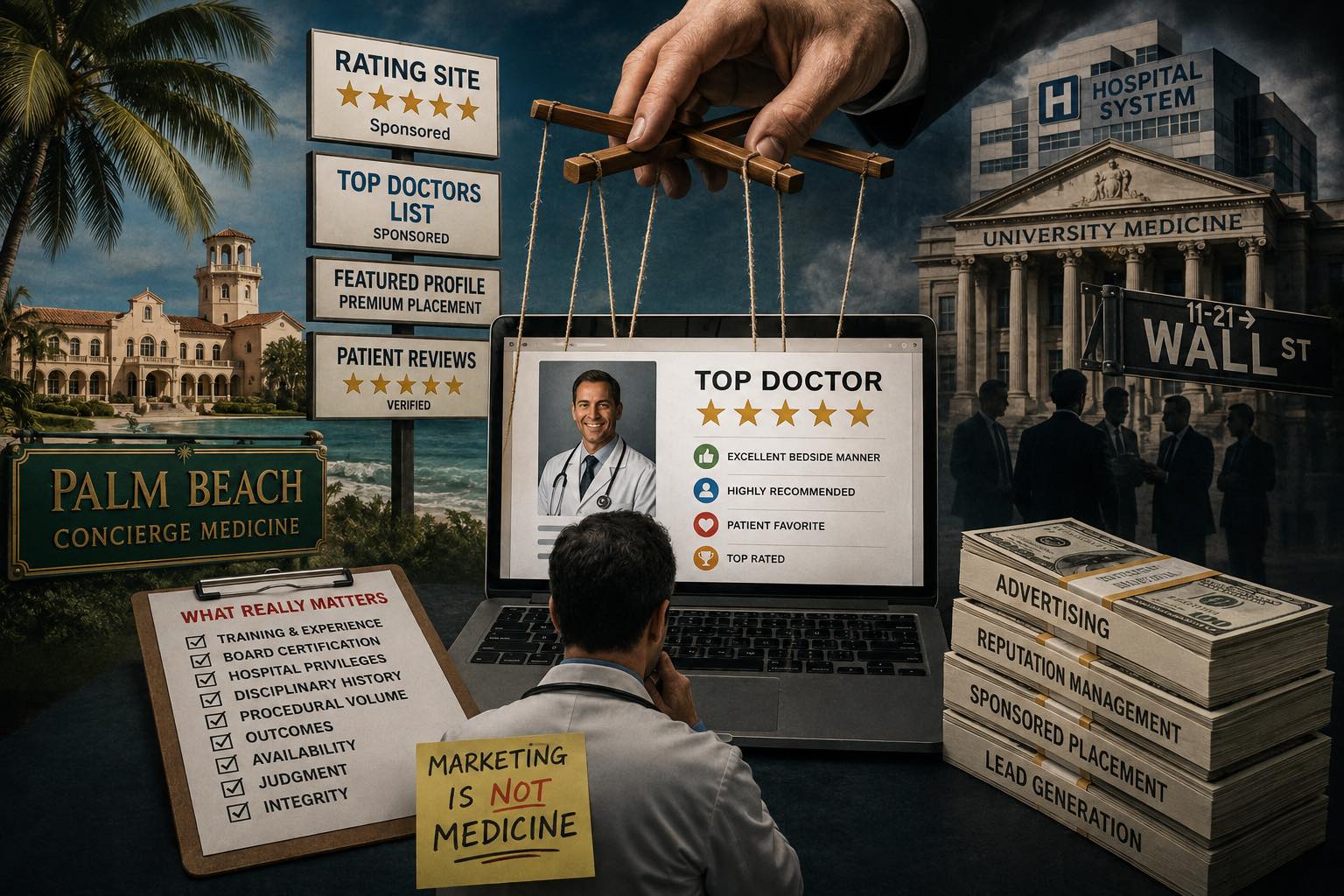
The modern physician-rating industry is not a medical peer-review system. It is a largely unregulated commercial marketplace built around advertising, search-engine visibility, reputation management, institutional promotion, patient acquisition, and profit. Stars, badges, sponsored profiles, “top doctor” lists, and favorable search placement can create the appearance of excellence without proving clinical competence, diagnostic judgment, procedural experience, accessibility, integrity, or long-term patient outcomes.
The central deception is simple: marketing is presented as medicine, popularity is presented as quality, and corporate visibility is presented as professional authority.
Some rating and directory sites sell advertising, enhanced profiles, sponsored placement, lead-generation services, or other promotional products to the same physicians and healthcare organizations they display to the public. Even when payment does not directly purchase a higher star rating, money may purchase greater visibility, more favorable positioning, richer profiles, or repeated exposure. The physician with the largest marketing operation can therefore appear more prominent than the physician with the deepest experience.
This is not an imaginary concern. The Federal Trade Commission has stated that fake, false, and deceptive reviews have “polluted the marketplace.” Its Consumer Reviews and Testimonials Rule, effective October 21, 2024, prohibits practices including buying or selling fake reviews, certain undisclosed insider reviews, review suppression, and businesses misrepresenting controlled review websites as independent.
A System That Can Be Gamed
Online scores can be influenced by selectively asking pleased patients to post reviews, using reputation-management companies, directing dissatisfied patients into private complaint channels, challenging unfavorable postings, and concentrating positive feedback during promotional campaigns. A physician who refuses to participate in this machinery may look less successful online despite having superior training and experience.
The numerical rating itself may be statistically meaningless. A handful of anonymous comments can determine a physician’s public reputation. Reviewers are rarely required to demonstrate medical knowledge, understand the reasoning behind a clinical decision, or distinguish an appropriate refusal from poor service. A physician may be attacked for declining unnecessary antibiotics, narcotics, tests, procedures, disability certifications, or medically inappropriate requests.
Doctors also face an extraordinary imbalance. A reviewer may publicly reveal a partial, distorted, or false account of an encounter. The physician cannot freely disclose the medical record to correct the story. The American Medical Association warns that HIPAA and state privacy laws continue to restrict a physician’s response even when the reviewer has publicly discussed the medical encounter.
The accusation can therefore travel around the world while the physician’s evidence remains locked inside a confidential chart.
The Power of Hospital and University Marketing Machines
Large hospital systems and university-branded medical organizations possess resources that independent physicians cannot match. They command multimillion-dollar advertising budgets, public-relations departments, search-engine specialists, media relationships, referral networks, sponsored content, fundraising operations, corporate partnerships, and control over large numbers of employed physicians.
These institutions can repeatedly publish claims about being “world-class,” “nationally recognized,” “leading,” “top-ranked,” or “the most advanced.” The public may reasonably assume that these descriptions have been independently proven. Frequently, however, the claims depend on proprietary surveys, selective statistics, institutional submissions, reputation polling, marketing language, or rankings whose methodology the ordinary patient has never examined.
A university name is not proof that the individual physician seeing the patient is a senior academic authority. A famous hospital logo does not guarantee direct access, continuity, independent judgment, or personal accountability. The patient may receive care through layers of employed physicians, rotating teams, advanced-practice providers, call centers, administrators, and referral protocols. The institutional brand receives the prestige, while the patient may never meet the celebrated specialist featured in the advertising.
Wall Street Medicine
Corporate and private-equity ownership has introduced another powerful force into medical visibility. Physician practices are increasingly acquired or controlled by hospital systems, insurers, corporate entities, and private-equity investors. The Government Accountability Office has documented the continuing consolidation of physician practices and reports evidence that some forms of consolidation are associated with higher prices, while effects on quality and access are mixed or incompletely understood.
These organizations are not passive owners. They understand branding, market capture, data analytics, referral retention, online reputation, and consumer behavior. When corporate medicine controls the practice, the advertising budget, the website, the scheduling portal, the patient survey, the referral pathway, and the public profile, patients must ask who is actually describing the quality of the care—and who benefits financially from the description.
This does not mean that every hospital-employed, university-affiliated, or corporate physician is unqualified. Many are excellent. It means that institutional power can magnify a physician’s public image far beyond what individual experience alone would produce, while accomplished independent physicians may be buried beneath sponsored results and corporate branding.
The Palm Beach Reality
Palm Beach has become a highly profitable market for concierge medicine. Wealthy patients are being pursued by university satellites, hospital systems, national concierge companies, corporate medical groups, newly converted membership practices, and aggressive digital marketers.
Patients may encounter luxurious offices, impressive websites, purchased advertisements, glowing testimonials, celebrity associations, institutional logos, and nearly perfect online ratings. None of these establishes that the physician has the training, experience, availability, or judgment required to manage complex disease.
Before selecting a Palm Beach concierge physician, patients should examine the physician—not merely the marketing:
Verify board certification, residency and fellowship training, academic history, hospital privileges, leadership experience, disciplinary history, years in practice, procedural volume, direct availability, emergency coverage, and who actually manages the patient after hours or in the hospital.
A five-star rating may measure satisfaction, convenience, or successful marketing. It does not measure whether the physician recognized a silent malignancy, prevented a stroke, managed cardiogenic shock, challenged an incorrect diagnosis, avoided an unnecessary procedure, or remained personally responsible when the case became difficult.
Medicine is not hospitality, branding, or digital applause. The best physician is not necessarily the physician the internet places first. The best physician is the one whose training, record, judgment, character, and personal commitment remain strong when the advertising is removed.